Yes, you can usually sell your car and keep your private number plate. If you want to retain a private plate, the important thing is to sort this out with the DVLA before the vehicle changes hands.
To do that, you apply to have the registration removed from the car. If the application is successful, you’ll be issued a V778 retention document, which confirms your right to keep the registration and use it again later. That means you can move your personalised number plate to another vehicle when the time is right.
You’ll also receive an updated V5C logbook for the car. In most cases, the vehicle will go back to its original registration number, which means you can go ahead with the sale without losing the plate.
For many owners, a private reg is more than just a number. It can have personal meaning, branding value, or resale value, so taking the proper steps to protect it before you sell is well worth doing.
What Are the Requirements for Retaining a Number Plate?
Before you take a private plate off a vehicle, the DVLA expects the car to meet a strict set of eligibility checks. These are the key DVLA conditions your vehicle must meet before you can retain a private number plate.
To qualify, the vehicle must meet the following strict DVLA standards:
- Be registered with the DVLA.
- Be capable of moving under its own power (the DVLA may arrange a physical inspection to verify this).
- Be a type of vehicle that requires an MOT or a goods vehicle test certificate.
- Have been continuously taxed or declared SORN for the past five years. If the vehicle is less than five years old, this rule applies to its entire lifespan since its first registration.
⚠️ What if your car has a gap in its tax history?
- If your vehicle has gaps in its tax or SORN history, the DVLA may ask for additional checks or refuse the application.
- If you are unsure about your vehicle's official registration timeline, running a quick Car Tax Check is an easy way to verify your vehicle tax history and spot any of these gaps before you submit your application.
How to Retain Your Number Plate (Step-by-Step)
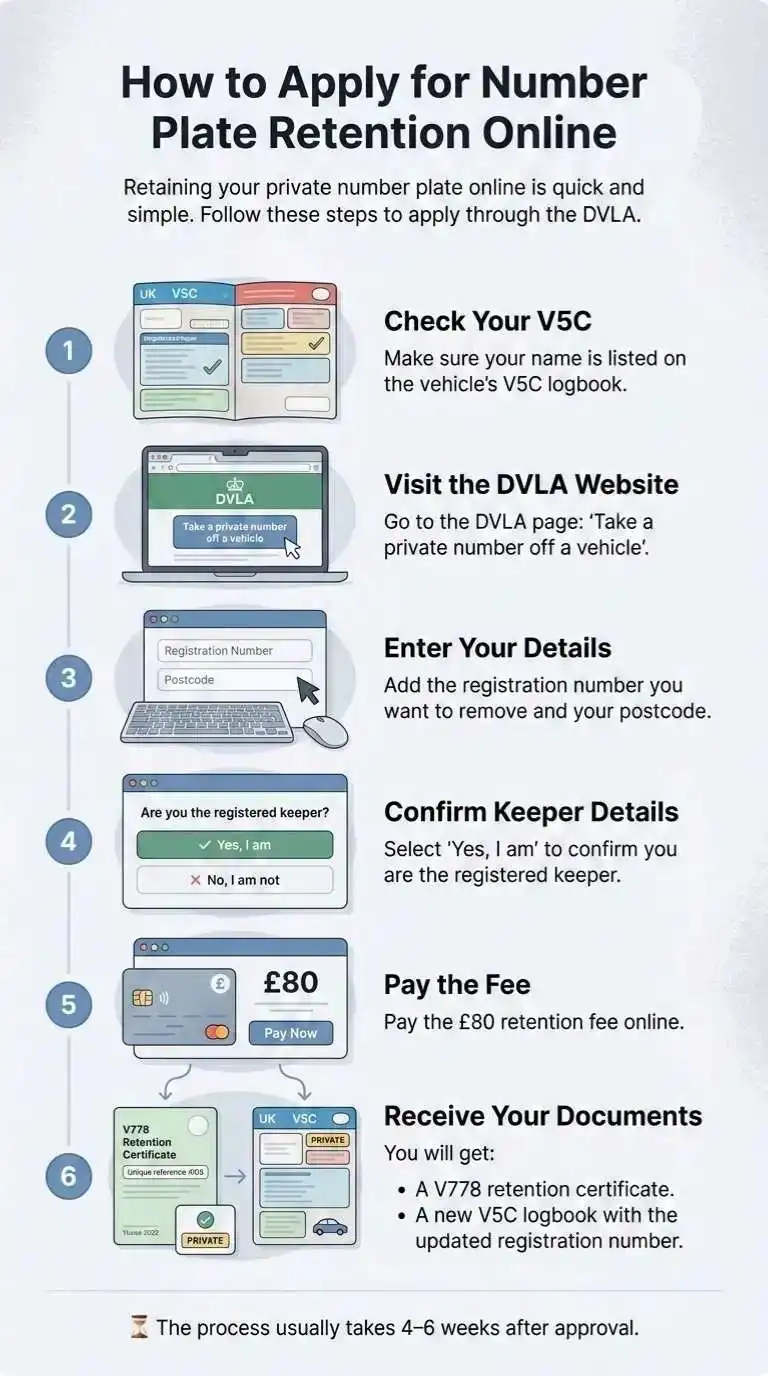
If you want to retain a private number plate, there are two main routes: online or by post. Whichever option you choose, complete it before you transfer ownership of the car. DVLA guidance is clear: remove the private registration and wait until the updated paperwork arrives before you sell, scrap, or hand the vehicle over.
Applying Online via the DVLA
For most private sellers, the online service is the simplest way to take a private plate off a car. You’ll need the 11-digit document reference number from your V5C, the registered keeper’s postcode, and a way to pay the £80 fee. GOV.UK provides a dedicated service for taking a registration number off a vehicle online.
A good practical check here is to use the latest logbook and enter the keeper's details exactly as DVLA holds them. Small mismatches can slow things down, which matters if you already have a buyer ready to proceed. The online route is generally the more straightforward option because the details are checked digitally as part of the process.
Applying by Post (V317 Form)
The postal route is still available if you prefer paper forms or need to deal with nominee details manually. In that case, download Form V317, tick Option B, complete the vehicle and applicant sections, include the original V5C logbook, and add a cheque, banker’s draft, or postal order for £80, payable to DVLA Swansea.
Send the application to:
- DVLA Personalised Registrations
- Swansea
- SA99 1DS
If you apply by post, make sure all documents are included before sending the application. Missing paperwork is one of the easiest ways to create avoidable delays, especially when a sale is already planned.
What to Do Once Approved (Road-Legal Checklist)
Getting your approval from the DVLA is only the administrative half of the process. Before you drive the vehicle or hand the keys over to a buyer, you must take these immediate physical steps:
- Fit Replacement Plates: You must physically change the plastic acrylic plates on the car to match the replacement registration number provided by the DVLA. It is illegal to drive a vehicle displaying registration plates that do not match its DVLA registration details.
- Update Your Insurance: Contact your car insurance provider immediately to update your policy with the new registration number. Failing to notify them of the change can invalidate your coverage if you need to make a claim.
What Documents Do I Need to Retain My Number Plate?
The key document is your V5C logbook. If you apply online, you’ll need the 11-digit reference number from the front page. If you apply by post, you must send the original logbook with the application.
If the V5C is missing, replace it first. You cannot retain a private number until you apply for a new logbook using a V62 form and pay the £25 replacement fee. It is worth sorting this out early because missing paperwork is one of the most common reasons sellers face delays.
What Happens After You Apply for Number Plate Retention?
Once approved, the DVLA will send a replacement V5C showing the car’s updated registration, usually within two weeks. In many cases, that means the vehicle goes back to its previous number, ready for original plates to be fitted if needed.
You should also receive a V778 retention certificate, often called the green retention document, within 4–6 weeks. If the DVLA wants to inspect the vehicle, they will contact you first. You should wait until these documents arrive before selling or transferring the vehicle.
Can I Sell My Car While Waiting for a Number Plate Transfer?
No.
- ⚠️ Important: Do not hand over your vehicle, sign the V5C logbook slips, or finalize a sale with a buyer until you have received confirmation from the DVLA that the plate has been successfully retained. If you transfer ownership of the vehicle prematurely, legal rights to the private registration pass entirely to the new buyer, and you will have no legal mechanism to recover it.
If you want to Retain Private Number Plate rights, wait until the paperwork is complete and the car is ready to be sold under its updated registration.
Can I Keep My Private Number Plate if My Car Is Written Off, Scrapped, or Stolen?
Yes, but timing is critical. If the car is written off, tell your insurer straight away that you want to keep the registration before the claim is settled. Once the insurer pays out, the vehicle is treated as sold to them, and if it is then scrapped, you can lose the right to the plate permanently.
If the vehicle is stolen, there is still a route to keep the registration, but this must be done by post using form V317 and the required supporting documents. In both cases, act before ownership and disposal are finalised.
- For Insurance Write-offs: If your vehicle has been written off, inform your insurer immediately that you want to keep the private registration. It is best to deal with the retention process before the insurance claim is finalised or the vehicle is scrapped, as ownership changes can affect your right to retain the number plate. The DVLA may also request supporting documents from the insurer during the application process.
Ensure a Smooth Sale: Verify Your Vehicle Details First
Before you apply to keep the plate or advertise the car, check that everything matches. Your V5C, DVLA record, and vehicle history should all be accurate, because even small errors can slow the process down or create avoidable questions for a buyer.
This is where a proper check helps. A full Car Reg Check lets you review the key details before you move forward; our Number plate checker can help you confirm the registration information you are relying on. It is a simple step, but it can make the sale feel far more straightforward and secure.
FAQs
How Do I Remove My Private Plate Before Selling My Car?
To retain a plate, apply to take the registration off the vehicle online or by post before you sell it. You’ll need the V5C, and you should not sell or dispose of the car until the updated log book has arrived. There is an £80 fee to remove the number.
Can I Pass My Private Number Plate to Someone Else?
Yes, you can. A private plate can be gifted or sold to someone else, but it needs to be transferred properly through the application process before it can be used on their vehicle. If you are naming someone else to use it, make sure their details are entered correctly from the start.
Can I Put My Private Registration Plate on a Financed Car?
In many cases, yes. The main thing to check is who the registered keeper is. If the V5C is in your name, the process is usually straightforward. If it is in the finance company’s name, speak to them first, so you know what they will allow.
Can I Put My Private Registration Plate on a Leased Car?
Yes, sometimes — but only with the leasing company’s agreement. The key point is that only the vehicle’s registered keeper can apply to transfer or retain a registration number, and on a leased car, that is often the leasing company, not you. It’s best to check with the leasing company in advance and confirm that they are willing to support the process, including removing the plate later if needed.
Do I Need to Apply for Number Plate Retention If I’ve Moved Address?
No. If the private number is on a vehicle, update the address on the V5C. If it is not on a vehicle, update the address on the V750 or V778 instead.
How Long Can You Keep a Retained Number Plate?
A retained number plate is normally valid for 10 years. If you still are not using it by then, you can renew the V778, and DVLA allows renewal up to 28 days before the expiry date.
Can My Application for a V778 Retention Certificate Be Denied?
Yes, it can. An application can be refused if the registration is not eligible to be retained, or if the request does not meet DVLA’s rules. For example, registration numbers beginning with Q or QNI cannot be retained. A request to renew a V778 may also be refused if it is submitted too early.