Bikes
Bikes Vans
Vans Motorhomes

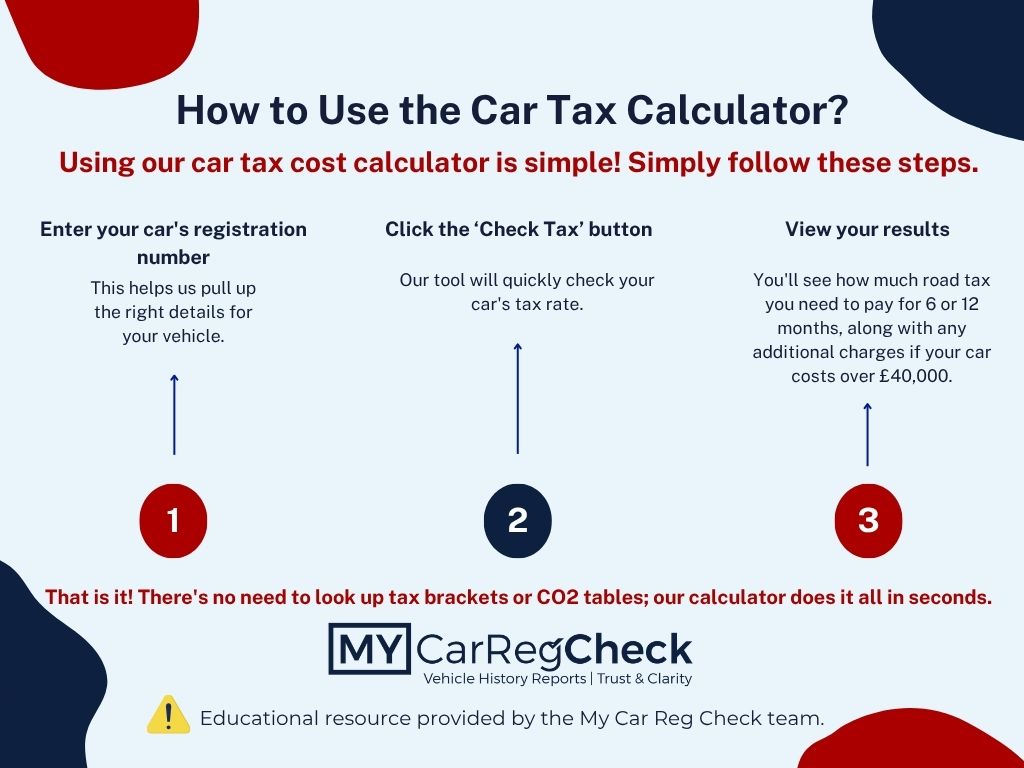
Enter your UK registration in our car tax calculator to quickly check the annual Vehicle Excise Duty (VED) for any vehicle using real-time DVLA data. Our tool uses the vehicle details linked to the registration to estimate the VED that may apply, so you can quickly get a clear idea of what the vehicle is likely to cost to tax each year.
If you are checking your own car, comparing a vehicle before you buy, or simply want a fast vehicle tax calculator, enter the registration to get started. Our car tax calculator by reg helps you check likely car tax rates in seconds, without needing to search through tables or guess which rules apply.
If you are comparing a car before you buy, it is also worth checking whether it has ever been written off with a car category check.
What's included in our car tax calculator?
Enter the registration for a quick number plate check, and we’ll show the vehicle’s tax details from DVLA records, so you can see the actual figures for that specific car, not just general vehicle tax rates.
- Annual VED cost – the yearly amount due for the vehicle, so you can quickly understand its likely running cost over the next 12 months.
- Current tax status – shows whether the vehicle is currently taxed. You should still check insurance and MOT status separately before using it on a public road.
- Tax expiry date – helps you see when the current tax ends and when the next renewal is due.
- SORN status – confirms whether the vehicle has a statutory off-road notification, which means it should not be driven or kept on a public road.
- Official DVLA tax band – useful for understanding how the vehicle sits within the tax system and why the yearly amount may differ from similar models.
- CO2 emissions rating – the vehicle’s CO2 emissions figure, which can affect tax for many newer vehicles.
- Engine size – especially helpful for older vehicles, where tax can be more closely linked to engine capacity.
- Car make and model – a simple check that the registration matches the vehicle you expect, which is particularly useful during a car check before buying.
How road tax (VED) is calculated in the UK
Vehicles first registered before 1 March 2001
For vehicles first registered before 1 March 2001, car tax is based purely on engine size. If the engine is 1549cc or below, it falls into the lower rate. If it is above 1549cc, it moves into the higher rate.
Vehicles first registered from 1 March 2001 to 31 March 2017
Tax is worked out using CO2 emissions and fuel type. These vehicles sit across 13 CO2 bands, so the amount can vary quite a bit depending on how much the car emits.
Vehicles first registered on or after 1 April 2017
The first year is based on CO2 emissions, which is why brand-new cars with higher emissions usually cost more to tax upfront. From the second year onwards, most cars move onto a flat standard annual rate. Diesel cars that do not meet the RDE2 standard pay higher first-year rates.
What is the additional tax rate shown on the report?
The extra tax rate shown on the report is the added charge for cars that had an original list price of more than £40,000 when new. The current extra charge is £440 per year, and it is paid on top of the normal annual VED rate, so it increases the total amount you pay each year.
This extra charge applies for 5 years, starting from the second time the vehicle is taxed.
If you are checking an older record or comparing past guidance, it is always best to look at the latest DVLA and GOV.UK tax tables, as the rate can change from one tax year to the next.
The 2025/2026 EV Tax Changes
From April 2025, electric vehicles stopped being fully exempt from VED. That means EV owners now need to factor in road tax in the same way as other drivers.
For cars registered on or after 1 April 2025, the first year is charged at the lowest first-year rate, and after that, the vehicle moves onto the standard annual rate. Electric cars first registered between 1 April 2017 and 31 March 2025 also pay the standard annual rate.
If the electric car’s original list price is above £50,000, the expensive car supplement can apply on top from 1 April 2026. So for some newer EVs, the yearly tax bill may include both the standard rate and an additional higher-value vehicle charge.
Pay or renew your car tax
If your tax has expired or is about to run out, renew it before driving the vehicle. There is no grace period, so once the tax has ended, the vehicle should not be used on the road until it is taxed again.
You can renew your tax:
- Online through GOV.UK
- By phone through DVLA
- At a Post Office branch that deals with vehicle tax
In most cases, you will need one of the following:
- Your V11 reminder
- Your V5C logbook
- The V5C/2 new keeper slip
- The right reference number from your documents
Your vehicle must also be insured and, if it needs one, have a valid MOT in place before you can tax it. If you are not sure whether the MOT is still valid, check that first using an MOT checker before starting the renewal.
You can usually pay monthly, every 6 months, or yearly, depending on what suits your budget. Just keep in mind that monthly and 6-month payments usually cost a little more overall than paying annually.
Failure to tax your vehicle or declare a valid SORN can lead to an automatic £80 penalty. If the issue continues, the vehicle could be clamped or impounded, your details could be passed to a debt collection agency, or the case could be taken to a Magistrates’ Court, where fines can reach up to £1,000 in some cases.
FAQs
What is car tax (Vehicle Excise Duty – VED)?
Car tax, officially called Vehicle Excise Duty (VED), is the tax paid to keep a vehicle taxed for use on UK roads. How much you pay depends on things like when the vehicle was first registered, its fuel type, CO2 emissions, engine size, and, in some cases, its original list price.
What information do I need to calculate my car tax?
If you are using our tool, the registration number is usually enough because we pull the key vehicle details from DVLA records for you. If you are trying to work it out manually or using a used car tax calculator before buying, the main things that affect the result are the registration date, fuel type, CO2 emissions, engine size, and sometimes the original list price.
Is car tax still free for electric vehicles?
No. From 1 April 2025, electric vehicles are no longer fully exempt from car tax. This means EVs now fall under the usual VED rules, and some higher-value electric cars may also have to pay the extra supplement if they meet the current price threshold.
Can I calculate the tax for a car I’m planning to buy?
Yes, and it is a sensible thing to do before you commit. If you have the registration, our car tax check calculator can help you see the likely yearly tax cost, which makes it easier to compare running costs before you buy.
How often should I check or calculate my car tax?
A quick check is usually enough when your renewal date is coming up, when you are buying a vehicle, or when tax rules have changed. If you already own the car, it is worth checking again before renewal, so there are no surprises.
How can I check if my vehicle has an additional tax rate?
The extra rate usually depends on the car’s original list price when new, not what you paid for it second-hand. If the vehicle crossed the qualifying threshold when it was first registered, the report may show an additional tax charge on top of the standard annual rate.
How accurate is the car tax information on the My Car Reg Check calculator?
Our calculator uses the registration to pull the vehicle details and apply the current car tax rules, so it should give you a strong estimate of what that vehicle is likely to cost. That said, the result is only as accurate as the vehicle record itself, so if the details have recently changed or the vehicle has an unusual classification, it is worth checking the official DVLA record and paperwork as well.
Why does the car tax vary between vehicles?
Car tax is not a one-size-fits-all charge. It can change depending on when the vehicle was first registered, its fuel type, emissions, engine size, and, in some cases, its original list price, which is why two similar-looking cars can still have different yearly costs.
What happens if my car tax expires?
If your car tax expires, you should not drive the vehicle until it has been taxed again, unless you are taking it to a pre-booked MOT where the rules allow it. Failure to tax the vehicle or declare a valid SORN can result in an automatic £80 fine, and continued non-compliance may lead to wheel-clamping, impounding, debt collection, or prosecution with fines of up to £1,000.
Does the car tax calculator work for vans, motorhomes, and company cars?
Yes, in most cases it does. A vehicle road tax calculator can often return tax details for vans and some motorhomes too, but those vehicles may be taxed under different rules from standard cars, so the result depends on how the vehicle is classified.
If you are checking a company car, the vehicle’s VED can still be checked in the usual way. Just bear in mind that company car tax is a separate benefit-in-kind issue: the vehicle’s VED is one thing, while the employee may also pay tax if the car is available for private use.
Why does my vehicle show “tax not available”?
This usually means the system does not have enough usable DVLA data to return a clear tax result for that vehicle. It can happen with certain imports, unusual vehicle types, recent record changes, or cases where the vehicle category affects how the tax is worked out.
If that happens, it is worth checking the paperwork and the vehicle classification more closely.
How much does the car tax cost in 2026?
There is no single answer for every vehicle, because car tax is still worked out under different systems depending on the vehicle’s age and type. For many cars first registered on or after 1 April 2017, the standard annual rate from 1 April 2026 is £200. Brand-new cars can cost more in the first year because that charge is emissions-based, and some higher-value vehicles may also pay an additional rate from the second year onwards.
So the easiest way to get a useful answer is to check the specific vehicle rather than rely on a general figure. That matters even more where the tax is rate-based on details like registration date, emissions, engine size, or vehicle class.