Bikes
Bikes Vans
Vans Motorhomes
Free DVLA SORN Check: Verify a Vehicle’s Off-Road Status Instantly
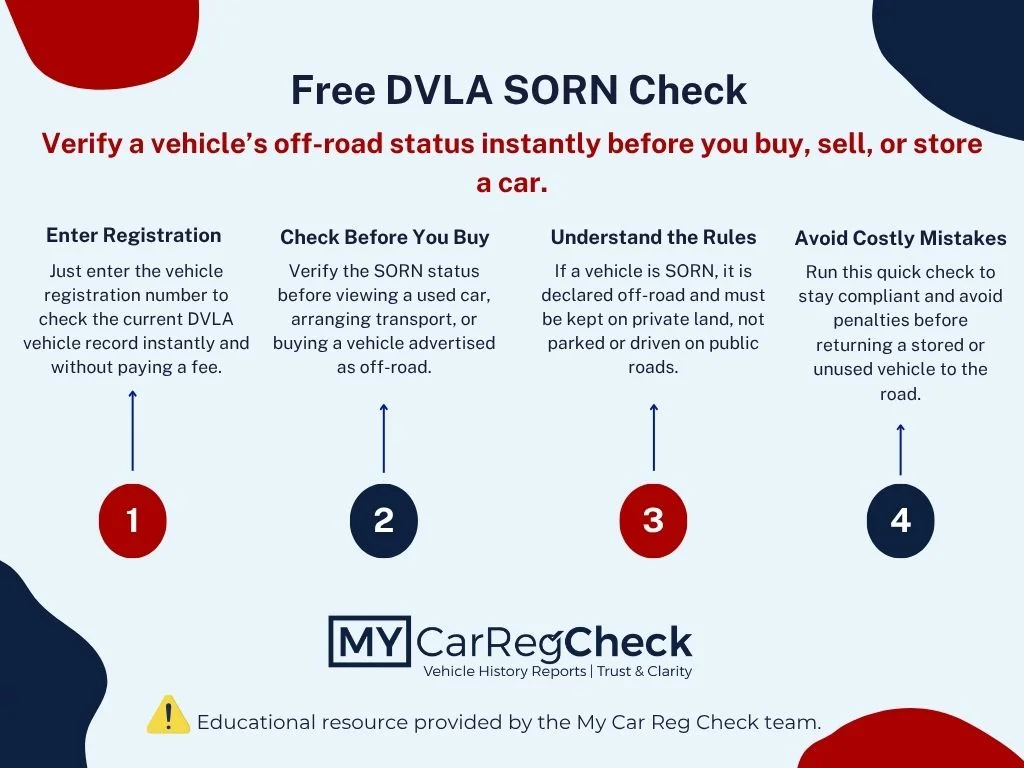
Use our free DVLA SORN check to see whether a vehicle is currently registered as SORN. Just enter the vehicle registration number now, and we will check the current DVLA vehicle record for you, so you can review the result in seconds without paying a fee.
This is the fastest way to check if a car is SORN before you buy, sell, insure, store, or return a vehicle to the road. A quick car reg check can help you avoid simple but costly mistakes, especially when a vehicle has been sitting unused, is changing owners, or is being advertised as off-road.
Our free vehicle SORN check is useful when you want to:
- Check SORN status before viewing a used car.
- Check a vehicle's SORN status after it has been stored or left unused for an extended period.
- Check SORN on vehicle records before arranging collection or transport.
- Confirm whether a car should be kept on private land rather than used on the road.
If the result shows the vehicle is SORN, that means it has been declared off-road with DVLA and should not be used or parked on a public road until it is properly returned to road use. DVLA’s vehicle information service can show a vehicle’s SORN status, along with tax and MOT information, using the registration number.
Enter the registration now to run your free car SORN check. It only takes a moment, and it gives you a clear starting point before you move on to a deeper vehicle history check.
What Does a SORN Status Mean on a Car History Report?
It means Statutory Off Road Notification. When our checker shows a vehicle as registered as SORN, it means the DVLA has been officially told that the vehicle is off the road and kept on private land, rather than used or kept on a public road.
This tells you the vehicle is not currently taxed for road use. It also means the keeper has formally notified DVLA instead of simply letting the tax or insurance lapse without action. That distinction matters when you are reviewing a car before purchase, storage, repair, or sale.
If our report flags a car as SORN, understand that this indicates a formal legal off-road status, not merely that the car has been unused recently. After declaring sorn, the vehicle must stay off public roads until the keeper taxes it again and meets the legal requirements for road use.
This changes the way car insurance requirements work for off-road vehicles. A vehicle kept off the road and declared SORN does not need active road insurance while it remains off-road. However, before driving your car again, you must sort the correct road-use requirements, which may also include valid MOT tests where required.
- A simple way to think about it is this: if you have declared your car as SORN, you have told DVLA it is not in active road use.
If you are checking a used car and see SORN status, treat that as a useful signal to ask why it was taken off the road, how long it has been stored, and what needs to be done before it can go back into normal use.
A SORN check can help you understand the vehicle’s legal road status and ask better questions about its history, but it is not designed to reveal personal information. It will not show registered keeper details.
Why You Must Check SORN Status Before Buying a Used Car
Checking SORN status before you buy is a simple way to protect yourself from avoidable problems. If a vehicle has been off the road for a long time, that does not automatically make it a bad buy, but it does mean you should inspect it more carefully and ask better questions about storage, maintenance, and why it was taken off the road.
A car that has been sitting idle can develop issues that do not show up in photos or a short driveway inspection. Long periods off the road can mean a flat or weakened battery, seized brakes, perished tyres, old fuel, corrosion, or fluids that have not been checked in months. That is exactly why a SORN result is useful to a buyer: it tells you the car may need more than a quick visual once-over.
It also gives you an immediate legal warning. If a car is SORN, it cannot be used on the public road for a normal buyer test drive. According to DVLA, a SORN vehicle can only be driven on a public road to or from a pre-booked MOT or other testing appointment, so a standard test drive on a public road is not something you should agree to while it remains off-road.
That matters because buyers sometimes assume they can “just take it around the block” if the seller is present. Attempting this could instantly make you legally liable for using an off-road vehicle on a public road.
Before anyone plans to use the vehicle normally, the keeper must tax the vehicle and make sure it meets the legal requirements for road use. Doing so could immediately put you in breach of the law.
A SORN flag is a prompt to slow down and verify more, not necessarily to walk away. Pair it with a MOT check and tax review, a VIN check, scrapped car check, and a car spec check so you can see whether the car’s identity, road status, and general history all line up before money changes hands.
The Legal Risks of Buying a SORN Vehicle
Buying a SORN vehicle is legal, but one of the biggest risks is assuming the previous keeper’s off-road status carries over to you. It does not. According to DVLA, SORN is not transferred when ownership changes, so as soon as you buy the car, you become responsible for either taxing it before road use or making a fresh SORN in your own name if it will stay off-road.
That matters because you cannot simply buy a SORN car and drive it home as it stands. To use it on the road legally, you need to tax it first, and road use also requires valid insurance and, where required, a valid MOT. The green V5C/2 new keeper slip can be used to tax the car before you drive it, even before the full V5C logbook arrives in your name.
If you are not putting the car back on the road straight away, the safest option is to move it by trailer or recovery truck and keep it off public roads. If you are not yet the registered keeper, you will usually need to complete the V890 DVLA SORN application form by post using the correct section of the V5C.
If the logbook is missing, you must apply for a replacement using form V62 (£25 fee). Note that this process can take up to 6 weeks.
Before you commit to the purchase, we recommend checking three things:
- whether the vehicle is still shown as SORN
- whether it has a valid MOT if you plan to use it on the road
- whether it is being kept on private land, not left on a public road in breach of the rules
In practice, this is where buyers get caught out. A seller may describe the car as “ready to go,” but if it is still under SORN and has no valid road-use setup in place, you could be left with a car you cannot lawfully drive away that day. Checking the status before payment helps you avoid that mistake.
⚠️Pro Tip: Vehicle Tax is Non-Transferable
A common mistake is assuming that any remaining tax stays with the car. Since 2014, vehicle tax is automatically cancelled the moment a car is sold. Even if the seller says the car is taxed, that tax ends the second you buy it.
SORN, Tax, and Insurance: Understanding the Continuous Insurance Enforcement (CIE) Rule
Here’s the simple rule: a vehicle must be in one of two legal positions. It must either be taxed and covered by car insurance for road use, or it must be officially declared SORN and kept off the road. DVLA checks this by matching vehicle records with the insurance database managed by the Motor Insurers’ Bureau, including Navigate and askMID services.
So, if a car is parked in a garage or on a driveway and you are not using it, you cannot just leave it untaxed and uninsured without action; a car tax check can help you confirm the vehicle's current tax status. You need to declare it SORN. If the vehicle is being used or kept on the road, it needs valid tax and insurance.
If neither is in place, penalties can follow. That can include an £80 DVLA penalty for an untaxed vehicle, a £100 insurance penalty under CIE, court fines that can rise to £1,000, and, in some cases, wheel clamping or seizure.
How to Legally Drive a SORN Car (The MOT Exemption)
A SORN vehicle cannot be used or parked on a public road as normal. The one practical road-use exception is a journey to or from a pre-booked MOT test or other official vehicle testing appointment. For any other road use, the SORN rules still apply.
There are two parts people often miss. First, the test must be booked in advance. Second, you still need valid insurance for that journey. A SORN does not give you a free pass to drive an uninsured car to the test centre. It is also sensible to run an MOT check before making plans to drive the vehicle anywhere.
This means:
- Yes, you can drive it to a pre-booked MOT
- Yes, you can drive it back from that test
- No, you cannot use that rule for a buyer test drive
Our advice is to keep the MOT booking confirmation with you and go straight there and back. If the journey is for anything other than that booked test, arrange a trailer or recovery vehicle instead. According to DVLA, using a SORN vehicle on the road for any other reason can lead to prosecution and a fine of up to £2,500.
How Our Free SORN Checker Works
When you enter a registration number into our free checker, we securely match it against trusted vehicle data sources to confirm the car’s current SORN position. That includes the official DVLA vehicle record, which is where SORN status can be checked using a registration plate.
We keep the process simple on purpose. You do not need to search the DVLA website yourself or work through separate checks just to see whether a vehicle is currently off the road. Enter the reg, and we return the result in seconds.
- This free check answers one important question: Is the vehicle legally recorded as SORN right now? That is useful for road legality, but it is only one part of the buying picture.
If you want deeper protection before you buy, our premium £7.99 report goes further. Alongside core vehicle data, premium history checks can draw on wider UK data sources used across the sector, including police, finance, and insurance records, to help uncover issues such as hidden finance, insurance write-offs, and stolen status.
So, think of it this way: a free SORN check helps you confirm road status, while the paid report helps you spot the risks a basic check cannot show.
FAQs
Does a SORN transfer to the new owner?
No. A SORN does not pass to the new keeper when a vehicle is sold. If you buy a SORN car, you must either tax it before driving it or make a new SORN in your own name if it will stay off the road.
Can I tax a SORN car online after buying it?
Yes. In most cases, you can tax a vehicle online after buying a SORN car by using the green new keeper slip from the V5C.
But taxing it is only part of the process. Before you drive it on the road, the vehicle must also have valid insurance and, if required, a current MOT. DVLA also makes clear that vehicle tax does not transfer from the previous owner to the new keeper
Will a SORN check show the registered keeper's details?
No. A public SORN or vehicle status check shows vehicle details such as tax and SORN status, but it does not show the registered keeper’s personal details. DVLA keeps that information separate.
How can I check if a car is declared SORN (Off the Road)?
Enter the registration number into our free checker to see whether the vehicle is currently recorded as SORN. You can also use DVLA’s vehicle information service, which checks tax and SORN status from the registration plate.