Bikes
Bikes Vans
Vans Motorhomes
Enter your registration to use our free car tax checker and see in seconds whether a vehicle is taxed, untaxed, or SORN.
A quick DVLA tax record check helps you confirm whether the vehicle is taxed or recorded as SORN. With one registration lookup, you can check vehicle tax, see the tax expiry date, and review related details such as MOT status and SORN status without relying on guesswork or outdated paperwork.
That matters more than many drivers realise. A car can look fine, drive well, and still be untaxed, off the road under SORN, or close to its renewal date. Checking first gives you a clearer picture of what the result means and what to do next, whether that is renewing tax, confirming MOT timing, or moving on to a full history check before committing to a purchase.
What Is a Car Tax Check?
A car tax check is a quick way to confirm whether a UK vehicle is taxed, untaxed, or recorded as SORN using its registration number. It helps you check vehicle tax status before you drive, buy, or sell a vehicle, and it can also show the road tax expiry date, MOT position, and key DVLA vehicle details.
That matters because a vehicle can look perfectly fine on a driveway or forecourt and still not be legal for use on a public road. A proper SORN check can reveal that a vehicle has been declared off the road, while the tax record helps you see whether it is currently covered or due for renewal.
This is especially useful in everyday situations. If you are buying a used car, it helps you confirm the tax position before collection. If you are selling, it helps you explain the vehicle’s current status clearly. If you are already the keeper, it is a simple way to avoid missing the tax expiry date and running into unnecessary problems.
Car Tax vs Road Tax vs Vehicle Excise Duty
Most drivers use “car tax” and “road tax” to mean the same thing. “Car tax” is the everyday phrase, while “road tax” is the older term many people still use when searching online.
The official term is Vehicle Excise Duty (VED). It is the formal DVLA term for the tax charged on vehicles, even though many people still use the older wording out of habit. So when people search any of these terms, they are usually looking for the same answer: whether a vehicle is taxed, when it expires, and whether it can legally be driven.
What Does Our Free Car Tax Check Include?
Our free check is designed to give you the information most people need first, without making you dig through multiple pages. If you want to check car tax by registration, confirm whether a vehicle is road legal, or spot an issue before you buy, the most important details should be clear at a glance and easy to understand.
Vehicle Tax Status
The first thing you will see is whether the vehicle is taxed, untaxed, or showing as expired. That matters because a vehicle can look ready to drive and still not be legally usable on a public road.
A taxed result shows there is currently a valid vehicle tax in place. Untaxed or expired status tells you to stop and check what has happened before driving, selling, or collecting the vehicle.
Road Tax Expiry Date
The tax expiry date shows when the current tax period ends. This is useful for owners who want to avoid missing a renewal, and for buyers who want to know whether the vehicle is close to running out of cover.
This helps you plan ahead instead of relying on memory or old paperwork. It is especially useful if the car has not been used for a while or has recently changed hands.
SORN Status
We also show whether the vehicle has been declared SORN, which stands for Statutory Off Road Notification. If a vehicle is SORN, it should not be driven or kept on a public road until it has been taxed and returned to legal road use.
This is one of the easiest things to miss when viewing a used car privately. A seller may say the car has been “off the road for a bit,” but the SORN record tells you what the official position is.
MOT Status and Expiry Date
Tax and MOT are separate, but they are closely connected in practice. A vehicle usually needs a valid MOT before it can be taxed, which is why many people also want to check the MOT alongside their tax lookup.
Seeing both together gives you a more complete picture. A car may be taxed today, but if the MOT is close to expiring, that could still affect what you need to do next.
DVLA Vehicle Details
Our free result also includes core DVLA vehicle details, so you can sense-check the record against the vehicle in front of you. That includes make, model, colour, fuel type, engine size, year of registration, and CO₂ emissions.
This is especially useful when buying a used car, because if the advert, the registration lookup, and the vehicle itself do not match, it is worth looking into properly.
Road Tax Cost and VED Band
Where available, we also help you understand the car tax cost and the VED band the vehicle falls into. Tax levels can vary depending on the vehicle’s age, emissions, registration date, and fuel setup, so two similar-looking cars may not cost the same to tax.
That can make a real difference when you are comparing vehicles, budgeting ownership costs, or deciding whether a deal still makes sense after the running costs are clear.
Free Car Tax Check vs Paid Vehicle History Check
If you simply want to know whether a car is taxed, a free check is the right place to start. But if you are buying a used vehicle, a paid history check gives you a wider risk picture, not just the current tax record.
| Check type | Best for | What it helps you see |
| Free car tax check | Quick status checks | Taxed, untaxed, SORN, tax expiry, MOT status, core DVLA vehicle details, and estimated car tax cost |
| Standard vehicle history check | Extra reassurance before buying | Adds more background on the vehicle beyond the basic tax and MOT view |
| Full vehicle history check | High-value or higher-risk purchases | Helps uncover issues such as finance, theft markers, write-off history, mileage concerns, and plate changes |
A free check tells you the vehicle’s current position. A paid check helps you judge whether the vehicle is a safe buy.
How to Check Car Tax Online for Free
If you want to check your own car tax or confirm the status of a vehicle you are about to buy, the process is simple. All you need is the registration number and a few seconds to review the result properly.
Step-by-Step Car Tax Check
Enter the registration number.
Type the number plate exactly as it appears on the vehicle. This is the quickest way to pull up the correct vehicle record.
Confirm the vehicle details.
Before trusting the result, make sure the make, model, colour, and fuel type shown in the report match the vehicle you are looking at. This helps avoid mistakes caused by entering the wrong plate number.
View the tax status.
Check whether the vehicle shows as taxed, untaxed, or SORN. This tells you straight away whether there may be a legal issue before the vehicle is used on the road.
Check the expiry date.
Look at when the current tax expires, not just whether it is active today. A vehicle that is taxed now may still need attention very soon.
Review MOT and SORN status.
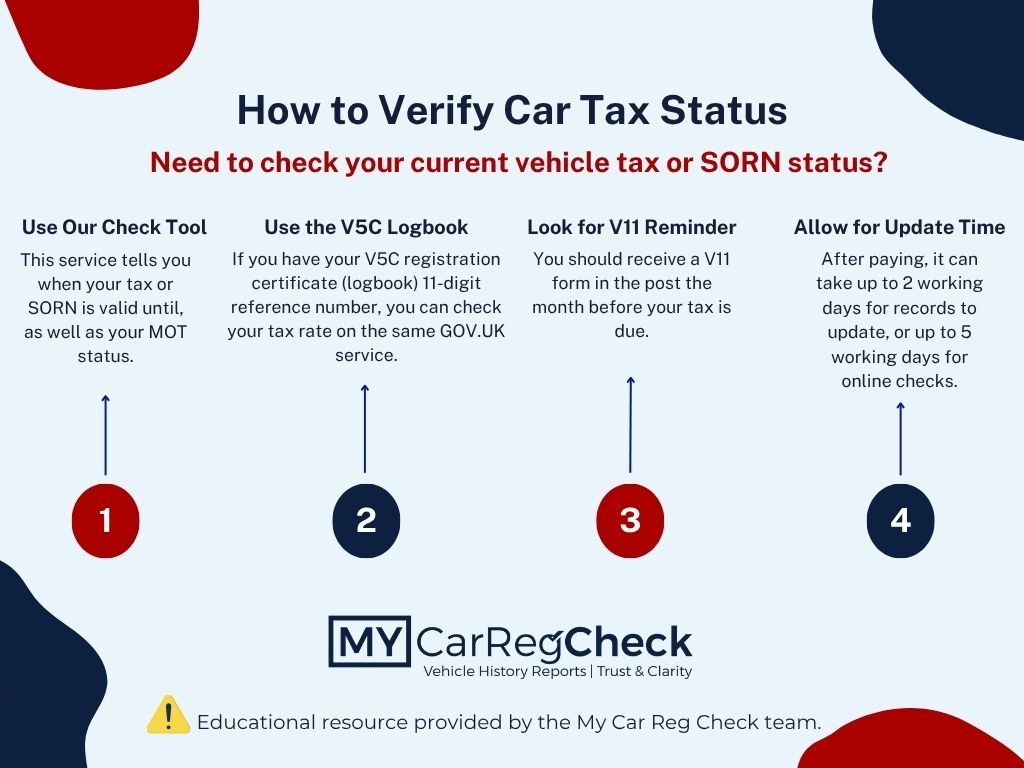
It is sensible to check the MOT status alongside your tax due date, because these often affect what you need to do next. If the vehicle is SORN, it cannot usually be driven until it is properly taxed again.
What to Do Next.
If everything looks right, you can move on confidently. If not, you may need to tax your vehicle, ask the seller questions, or run a fuller history check before making a decision.
How to Tax a Vehicle After Checking Its Status?
If your check shows the vehicle is untaxed, expired, or no longer covered after a change of keeper, the next step is to sort the tax before it goes on the road. This is especially important with used cars, because the tax does not carry over to the new owner. In most cases, the easiest way to pay road tax is through the official GOV.UK vehicle tax service.
Taxing a Car Online Through the DVLA
The fastest option for most drivers is online. You can usually tax the vehicle using the V11 reminder, the V5C logbook if it is in your name, or the 12-digit reference from the green new keeper slip if you have just bought the car.
How to Pay Car Tax by Phone
If you prefer, you can also arrange to pay vehicle tax by phone through the DVLA automated service. You will need the relevant vehicle document details, such as the V5C or new keeper slip, before you call.
Taxing a Car at the Post Office
Some authorised Post Office branches handle vehicle tax in person. Take your V5C logbook or green new keeper slip, and the branch can usually process the tax there and then.
Accepted Car Tax Payment Methods
Payment options vary, but most drivers can pay by debit card, credit card, or Direct Debit. Direct Debit can usually be set up for monthly, 6-month, or 12-month payments, while other methods are commonly paid in fixed terms.
What Documents Do You Need to Tax a Car?
In most cases, you can tax a car with one of three things: your V11 reminder letter, your V5C logbook if it is in your name, or the green V5C/2 new keeper slip if you have just bought the vehicle. If you do not have any of those, you will usually need to apply for a replacement logbook before you can finish the process.
You will also need the vehicle to meet the legal requirements for road use, including a valid MOT where one is required. In some cases, extra documents may be needed when taxing a vehicle at a Post Office, particularly in Northern Ireland.
Can You Tax a Car Without a V5C Logbook?
Yes, sometimes. If you have just bought the vehicle, the green V5C/2 new keeper slip is usually enough to tax it online or at a Post Office that deals with vehicle tax.
If you have lost the logbook, you may need to apply for a replacement using form V62 before the vehicle can be taxed. This usually becomes an issue when you do not have either document, because DVLA may need to update or confirm the keeper record before the vehicle can be taxed.
When Does the Car Tax Start and End?
If you buy a used car, the tax starts from the day you tax it in your own name. It does not carry over from the previous keeper. Vehicle tax does not transfer to the new owner, so the car needs to be taxed again as soon as ownership changes.
When you sell the vehicle or declare it off the road, DVLA cancels the tax, and any refund is usually based on full unused months, not partial months. If you pay by Direct Debit, renewal continues automatically until it is cancelled.
When Can You Not Tax a Vehicle?
There are a few common reasons why you may not be able to tax a vehicle. The most common are a missing or invalid MOT where one is required, the wrong keeper details on the DVLA record, or not having the correct reference number from a V5C, V11, or new keeper slip. If you have just bought the vehicle and the paperwork has not caught up yet, that can also slow things down.
What Happens If You Drive Without Car Tax?
If a vehicle is untaxed and not exempt, it cannot legally be used or kept on the road. In practice, that can lead to penalty letters, clamping, the vehicle being taken away, and extra release or storage fees. DVLA also uses enforcement cameras, including ANPR, and the usual late licensing penalty is £80, although this is reduced to £40 if paid within 33 days.
Are Any Vehicles Exempt From Road Tax?
Yes, some vehicles are exempt from paying vehicle tax, but that does not always mean you can ignore the paperwork. In many cases, the vehicle still needs to be taxed or moved into the correct tax class at a zero rate, so the DVLA record stays current, and the vehicle remains legal to use.
Disabled Tax Class Vehicles
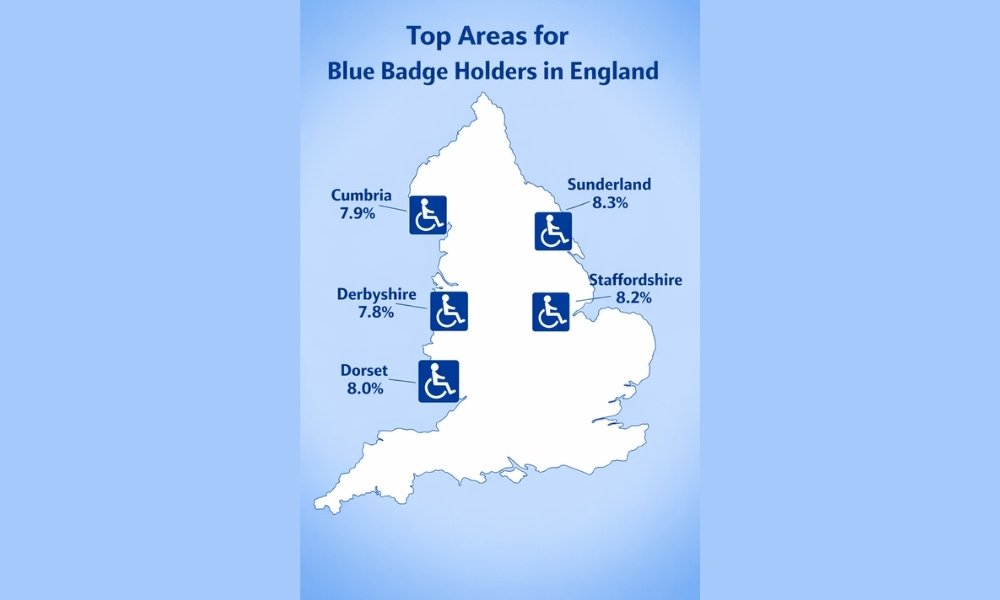
A vehicle can qualify for free tax if it is used by a disabled person who receives certain qualifying mobility benefits. In some cases, the same exemption can also apply to a vehicle used by an organisation that transports disabled people.
The exemption can normally only be used on one vehicle at a time.
Historic Vehicles Over 40 Years Old
Historic vehicles can become exempt on a rolling 40-year basis, but they usually need to be moved into the historic tax class first. That is why an older car can be old enough to qualify yet still need the exemption to be claimed properly.
Agricultural, Forestry and Off-Road Vehicles
Some agricultural machines, tractors, mowing machines and other specialist off-road vehicles can qualify for exemption or a special tax class. That eligibility depends on the vehicle type and how it is actually used, not just on how the owner describes it.
Electric and Low-Emission Vehicles
This is one area where the rules have changed in recent years. Electric, zero-emission and low-emission cars, vans and motorcycles are no longer usually exempt from vehicle tax. Since 1 April 2025, most vehicles have needed to be taxed, with the rate depending on the type of vehicle and when it was first registered.
Car Tax Bands Explained
Car tax bands make more sense when you think of them as three main registration eras, not one single system. For cars registered before 1 March 2001, tax is based mainly on engine size. For cars registered between 1 March 2001 and 31 March 2017, it is based mainly on CO₂ emissions and fuel type. For cars first registered on or after 1 April 2017, the first year is emissions-based, then most move onto a standard annual rate.
That is why two cars that look similar can have very different car tax rates. Older cars are judged more by engine size, mid-era cars by emissions bands, and newer cars by a mix of first-year emissions, later standard rates, and sometimes list price.
There is also an expensive car supplement for certain higher-value vehicles. For many petrol or diesel cars, this applies if the list price was over £40,000. For many electric cars, the threshold is over £50,000.
The extra charge applies for 5 years, starting from the second time the vehicle is taxed.
MOT, Insurance and Car Tax: How They Work Together
Tax, MOT, and insurance work together, but they are separate legal requirements. In other words, passing one check does not automatically prove the others are in place.
A free tax check can tell you whether the vehicle is taxed and whether it is recorded as SORN, and you can separately check MOT status. It does not prove the vehicle is insured, which is why GOV.UK points people to askMID for insurance checks.
Tax keeps the DVLA record in order, MOT helps show the vehicle meets minimum roadworthiness standards, and insurance covers legal road use. If one is missing, the vehicle may still not be legal to drive even if the other two are in place.
SORN Status Explained
SORN means Statutory Off Road Notification. You declare SORN when a vehicle is being taken off the road, and you want to stop taxing and insuring it, for example, if it is being kept in a garage, on a driveway, or on private land instead of on a public road.
A SORN vehicle does not need vehicle tax while it remains off the road, but it also cannot normally be driven. The main exception is travel to or from a pre-booked MOT or other testing appointment. Once SORN is in place, it applies until the vehicle is taxed again, sold, exported, or scrapped.
If you want to put the vehicle back into use, you tax it again in the normal way, and the SORN ends automatically. If there was tax left when the SORN was made, any refund is usually based on the full remaining months.
Buying a Used Car? Why a Car Tax Check Is Essential
A car tax check is one of the quickest ways to spot problems before money changes hands. It helps you confirm whether the car is taxed now, whether it has been declared SORN, and when the MOT runs out. Just as importantly, it helps you sense-check the basics, such as make, model, colour, and fuel type, against the advert and the vehicle in front of you.
This matters because the tax on a used car does not transfer to the new keeper when it is sold. So even if the car looks ready to drive away, the buyer must tax it in their own name before using it on the road.
A tax check is a smart first step, but for a used purchase, it works best alongside a full vehicle history check covering finance, theft markers, write-off history, mileage issues, and number plate changes.
Why Use Our Car Tax Checker Instead of GOV.UK?
GOV.UK is the official source for vehicle tax services, and it is the right place to tax a vehicle, manage refunds, or deal directly with DVLA. Our checker is designed to make the same kind of information easier to read and place it alongside related details, such as MOT status, key vehicle specifications, and the option to continue into a wider used car check when you need more than a basic tax result.
It puts tax status, MOT details, and key vehicle information in one place, so you can make sense of the result faster. For a routine ownership check, that saves time. For a used car purchase, it gives you a clearer starting point before you decide whether deeper checks are worth paying for.
Why Trust Our Car Tax Check Data?
When you run a car tax check, you want clear information you can act on, not vague summaries or hard-to-read records. That is why we present key vehicle details in a simple format, including tax status, SORN status, MOT expiry, and core registration information, so you can understand the result quickly and use it with confidence.
Our data is based on official UK vehicle information sources and DVLA-linked records where relevant. That means the check is designed to reflect the same core details drivers rely on when confirming whether a vehicle is taxed, off the road, or due for MOT.
Just as importantly, using our checker does not change anything on the vehicle’s record. It is a read-only lookup, so checking a registration will not affect the vehicle’s tax position, MOT history, or DVLA file.
Where a legal decision matters, such as taxing a vehicle, confirming an exemption, or resolving a record issue, the final step should always be taken through the official GOV.UK or DVLA service. Our role is to help you get the information quickly, understand what it means, and decide what to do next.
Common Car Tax Check Problems and Fixes
Most problems with a car tax check are not serious. In many cases, the issue is simply a delay in the record updating, a recent change of keeper, or a registration number entered incorrectly. Before assuming something is wrong with the vehicle, it is worth checking the obvious points first.
Why Is My Vehicle Tax Information Incorrect?
If the result looks wrong, the record may not have been updated yet. This is quite common after a vehicle has just been taxed, declared SORN, or transferred to a new keeper. In short, the information you see may be slightly behind the real-world change.
What If My MOT Has Updated But Tax Has Not?
MOT and tax records do not always refresh at the same time. A vehicle may have passed its MOT, but the tax record may still take a little longer to catch up. If that happens, give it a short while and check again rather than assuming the update has failed.
What If I Entered the Wrong Registration Number?
This happens more often than people think. A single wrong character can bring up the wrong vehicle or no useful result at all. If the make, model, colour, or fuel type does not match what you expected, the first step is to re-enter the registration carefully.
What If the Vehicle Has Recently Been Bought or Sold?
This catches a lot of people out. When a vehicle is sold, the old tax does not pass to the new keeper, so the buyer must tax it again in their own name. During that changeover, the record may not always look the way the buyer or seller expects straight away.
Check Car Tax for Cars, Vans, Motorbikes and Other UK Vehicles
Our checker is not just for everyday cars. You can use it to check tax status for vans, motorcycles, motorhomes, commercial vehicles, classic cars, pickups, mopeds, and scooters as well.
That matters because different vehicle types can be taxed under different rules, and older vehicles may follow a different system from newer ones. Whether you are checking a family hatchback, a delivery van, a touring motorhome, or a classic weekend car, the first step is the same: confirm the vehicle’s current tax position before you assume it is ready for the road.
If you are comparing ownership costs, it also helps to find which tax band your vehicle falls into and review the wider record before you make a decision.
Check Your Car Tax Status Now
Enter your registration number above to check tax status, MOT expiry, SORN status, and key DVLA vehicle details in seconds. If you want to look beyond the basic result, you can also use our tools to calculate car tax, review MOT history, or take the next step with a full vehicle history check.
If you also drive in London, you can use our Clean Air Zone check to see whether your vehicle may be affected by charges.
Car Tax Check FAQs
How do I check my car tax status in the UK?
Enter the registration number into a vehicle tax checker and review the result. You can check whether the vehicle is taxed or SORN; you only need the number plate to do this.
Can I check the car tax for a vehicle I don’t own?
Yes. Vehicle tax status can be checked using the registration number alone, so you do not need to be the owner or registered keeper to look it up. That is one reason tax checks are useful when you are viewing a used car.
Can I tax a car without insurance?
Absolutely not. Motor insurance is a strict legal prerequisite for vehicle taxation. The DVLA, the automated MOT registry, and the Motor Insurance Database (MID) are completely linked digitally. The moment you enter your details to pay your vehicle tax, the system checks for insurance cover. If there isn’t an active policy on record, the database will flag it and refuse to process your tax.
Can I tax a car without a valid MOT?
Usually, no, if the vehicle is old enough to need an MOT. You may need to show evidence of a valid MOT; MOT records can take up to 2 days to update after a pass.
Can I drive a car home without tax after buying it?
No, tax does not transfer to the new keeper, so the vehicle needs to be taxed again in the buyer’s name before it is used on the road.
Does the car tax transfer when I sell my car?
No, it stays with you, not the car. When you tell DVLA that you have sold or transferred the vehicle, the existing tax is cancelled, and the buyer has to tax it again in their own name before driving it away.
If there is any tax left, DVLA will usually send the refund automatically by cheque. It is sent to the name and address on the vehicle log book, and it only covers any full months left when DVLA receives the update.
Which vehicles are exempt from car tax?
Some vehicles can qualify for exemption, including certain vehicles used by disabled people, some mobility vehicles, qualifying historic vehicles, and some specialist agricultural vehicles. The exemption depends on the vehicle type and, in some cases, how it is used.
Do exempt vehicles still need to be taxed?
Usually, yes. In many cases, “exempt” means you do not have to pay, but you still need to tax the vehicle at a zero rate so the record is kept up to date. This catches people out quite often, especially with historic or disability-related exemptions.
What is SORN?
SORN stands for Statutory Off Road Notification. It tells DVLA that a vehicle is being kept off the road, so it does not need vehicle tax while it remains off public roads. A SORN vehicle cannot normally be driven until it is taxed again, except in limited cases such as a pre-booked MOT appointment.
Does checking car tax affect DVLA records?
No. Checking a vehicle’s tax status is just a lookup, not a change to the record. It helps you view the current position, but it does not tax the vehicle, cancel tax, update keeper details, or alter the DVLA file. Changes only happen when someone takes a separate action through the relevant DVLA or GOV.UK service.