Bikes
Bikes Vans
Vans Motorhomes
Our free car mileage check lets you check car mileage online for any uk vehicle using its registration. You can review recorded mileage readings and MOT mileage history to spot incorrect mileage, unusual sudden drops, or signs a car has been clocked through possible odometer tampering.
To keep it clear: the free part is the mileage check only. If you want a wider car reg check or bike check before buying a used vehicle, our full history check is £7.99.
How to Check a Car's Mileage History
Checking a car’s mileage with My Car Reg Check is simple:
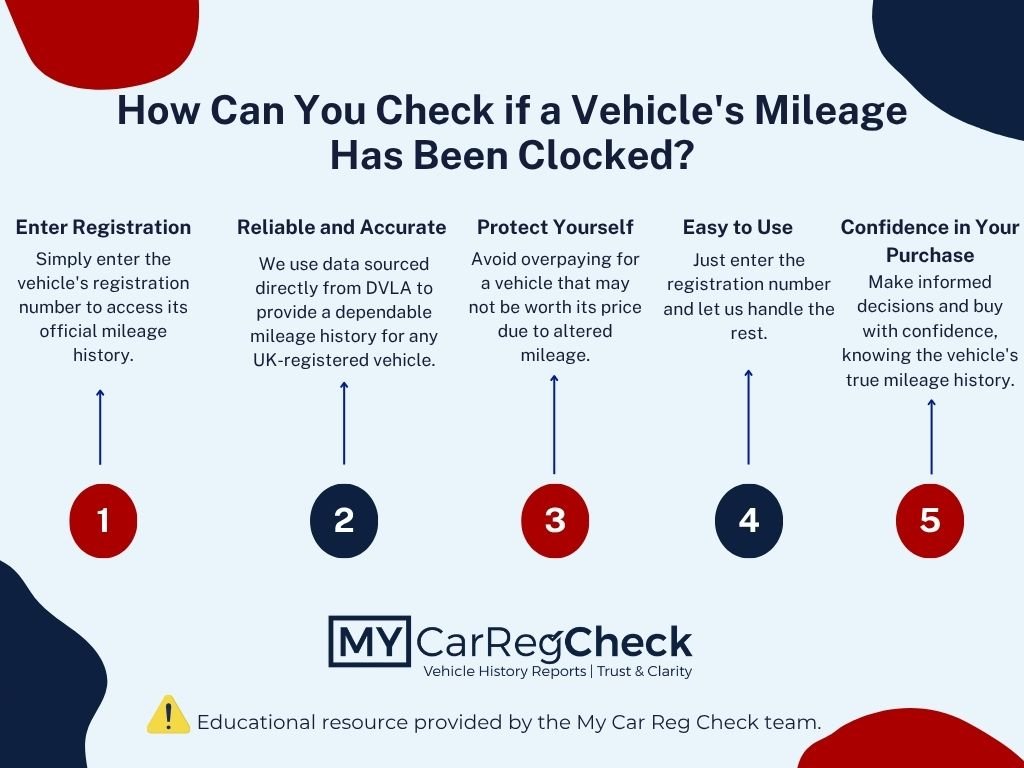
- Enter the registration to start your car mileage check.
- We query DVSA mileage records to build a mileage history report for that vehicle.
- Review the timeline to check car mileage history and look for drops, unusual gaps, or readings that do not follow a normal pattern.
If the recorded mileage goes backwards or increases far less than expected between MOT tests, it can point to a possible problem. That is where a mileage discrepancy check helps you decide whether the vehicle’s recorded history makes sense before you go any further.
Check Car Mileage History (Infographic)
Free vs. Comprehensive Mileage Checks: What’s the Difference?
Our free check shows the car’s DVSA MOT mileage history only. You can use it to check car mileage, review past recorded readings, and see whether the mileage pattern looks normal.
Our £7.99 full history check includes more than mileage. It adds important background checks such as MOT history, BHP, stolen status, outstanding finance, write-off history, and salvage history.
In simple terms:
- Free mileage check: MOT mileage timeline only
- £7.99 full history check: mileage + wider vehicle risk checks
That is the key difference. The free check helps you spot possible mileage concerns, while the paid report gives you wider checks, including a vehicle identification check, to help you decide whether the car is safe to buy overall.
Why Mileage Fraud (Clocking) is Rising in the UK
Mileage fraud is rising because the incentive is stronger and the tools are easier to access. Many modern cars store the vehicle’s mileage electronically in their Electronic Control Units (ECUs), but cheap mileage correction devices can be used to alter the dashboard reading and create an odometer rollback with very little visible trace.
At the same time, more drivers are using PCP, leasing, and other car finance agreements that come with strict mileage caps. When excess mileage charges apply at the end of the deal, some sellers are tempted to reduce the reading to protect the car’s value or avoid a lower settlement position.
For buyers, that creates a real risk. A clocked car may look like a better value than it really is, but the hidden extra wear and tear can lead to bigger repair costs and a misleading price.
That is why we always suggest looking at more than one clue. Check the mileage timeline, then compare it with the car’s service history and service records to see whether the story is consistent.
If you are looking at a Volkswagen, a VW service history check can add another useful point of comparison.
How to Spot a Clocked Car Before You Buy
A mileage timeline is a strong starting point, but it should never be your only check. Before you buy, look for signs that the car’s condition does not match the mileage being claimed.
Check the cabin first:
- A heavily worn steering wheel on a supposedly low-mileage car is a warning sign.
- Smooth or badly worn pedal rubber can point to far more use than the odometer suggests.
- A sagging driver’s seat bolster, shiny or faded buttons, and a worn gear knob can also point to higher real-world use than the mileage suggests.
Then look at the front of the car. Lots of stone chips on the bonnet, mirrors, or front bumper often suggest sustained motorway driving, which can be out of step with a very low reading.
Paperwork matters just as much as condition. Compare the V5C logbook and DVLA record with dated service receipts, workshop invoices, and stamped records to see whether the mileage rises in a steady, believable way.
Be careful if the documents are vague or incomplete. A seller may show a stamped service book, but detailed service invoices are often more useful because they usually show the exact date, mileage, work completed, and the garage that carried it out.
It also helps to judge the story as a whole. If a ten-year-old car looks heavily used but the mileage appears unusually low, ask why, and be cautious if the explanation does not match the evidence.
If the car has a recent MOT, compare the latest recorded mileage with the vehicle’s overall condition, paperwork, and full vehicle specification. When the physical wear, the paperwork, and the recorded history all line up, you are in a much stronger position to buy with confidence.
Where Does Our Mileage Data Come From?
Our mileage data comes directly from the Driver and Vehicle Standards Agency (DVSA), using official MOT mileage records for UK vehicles. When you check a registration with us, you can see the mileage readings recorded during previous MOT tests, helping you understand how the vehicle’s mileage has changed over time.
There is one important limitation to understand. Cars under 3 years old usually do not need an MOT yet, so there may be no official DVSA mileage data available for them at all.
That does not always mean something is wrong. It often just means the car is too new to have entered the MOT system, which creates a genuine gap before the first official mileage record appears.
For newer cars, we suggest asking to see dealer service records, maintenance invoices, and any stamped service book entries. Together, these can help you trace the car’s early mileage and see whether the claimed reading looks believable before the first MOT record exists.
If you are looking at a nearly new vehicle, this extra step matters. A clean-looking dashboard reading is useful, but paperwork from servicing and routine maintenance is often the best way to support the claimed mileage during that first 3-year window.
What to Do If Your MOT Mileage is Recorded Incorrectly
If your MOT shows the wrong mileage, act as soon as you spot it. The right route depends on how long it has been since the test.
- If the MOT was carried out in the last 28 days, contact the same MOT test centre that did the test and ask them to correct the mileage entry.
- If it has been more than 28 days, you will normally need to raise it with the Driver and Vehicle Standards Agency (DVSA) instead.
Before you contact anyone, gather proof of the correct reading. The strongest evidence is usually service invoices, workshop receipts, previous MOT paperwork, and other dated records that show the mileage clearly.
It helps to keep your evidence in order by date. If the paperwork shows a steady mileage pattern before and after the incorrect entry, it is much easier to demonstrate that the MOT record is wrong rather than suggesting the vehicle has been clocked or has an unexplained mileage discrepancy.
The key is not to ignore it. One wrong entry can create a false mileage discrepancy on the record, which may raise questions later when you sell the car or when a buyer checks its history.
Our Trustpilot Reviews
Many drivers in the UK trust My Car Reg Check. Read what they have to say about us on our Trustpilot profile.
FAQs
Is odometer clocking illegal in the UK?
What matters most in law is the sale. According to the UK government, it is a criminal offence to knowingly sell a car that has been clocked, so if a seller hides altered mileage or misrepresents the vehicle, that crosses the line into fraud.
What is considered “good” mileage for a used car?
There is no single “good” number that fits every car. A sensible starting point is to compare the mileage with the car’s age.
According to RAC, the average UK annual mileage is around 7,000 miles a year. A car that sits near that range can look normal on paper, but you should still check the service history, MOT history, and the car’s overall condition to see whether the mileage makes sense.
Can a mileage discrepancy just be a typing error?
Yes, it can. DVSA guidance makes clear that mileage mistakes do happen on MOT records, which is why there is a correction process: if the MOT was within the last 28 days, the original test centre can update it after checking the vehicle; after that, the error has to be reported to DVSA with proof of the correct mileage.
How do I report a clocked car?
If you think a car has been clocked, start by saving everything that supports your case. That includes the advert, sale receipt, MOT history, service invoices, and any messages between you and the seller.
According to
Citizens Advice
the usual way to report a seller is through the Citizens Advice consumer service, which can pass your report to Trading Standards. If you want help before reporting it, you can also use the
consumer service contact page
.
Can I get my money back?
Possibly, yes. According to Citizens Advice, if a used car was advertised or described inaccurately, you may be entitled to a repair, reimbursement for repair costs, or a partial or full refund.
If you bought from a private seller and the mileage was falsely described, you should first complain to the seller in writing. This Citizens Advice letter template can help you explain the issue clearly and request a refund or other suitable remedy.