Bikes
Bikes Vans
Vans Motorhomes
Enter your UK number plate below, and we’ll show you the car specs in seconds.
Our free vehicle spec check helps you confirm the registered make and model, engine size, fuel type, transmission, and key dimensions before you buy, sell, insure, or compare a vehicle.
Check the registered details of a vehicle before you buy, sell, insure, or compare it. You can check car specs by reg to spot the wrong engine, an unexpected gearbox, or a model variant that does not match the asking price. It also gives you useful details such as CO2 emissions, fuel type, and registration date that can help you calculate the car tax and running costs more accurately.
With My Car Reg Check, you can quickly review factory specifications, engine details, and practical information such as body style, weight, and size.
What Is a Car Spec Check and What Does It Show?
A car specification check shows the official technical and registration data linked to a vehicle’s registration number, so you can check vehicle specs against what a seller says. That matters because two cars with the same badge can have different engines, different trim levels, and different running costs.
Our car spec checker uses DVLA registration records, DVSA MOT data, and trusted manufacturer specifications to show the registered vehicle details for that exact vehicle. This gives you a more reliable picture than relying on an advert, a model badge, or a seller’s memory.
Our free report includes:
- Make, model, body style, and trim
- Year of manufacture and original registration date
- Engine capacity and fuel type
- Power output and torque
- Transmission type and drivetrain
- Fuel economy figures
- CO2 emissions and the Euro emissions standard
- ULEZ or Clean Air Zone compliance
- Kerb weight and other core dimensions
- Number of doors and seats
- V5C issue date and MOT history
This is especially useful when buying a used car. You can compare the official vehicle information with the advert and quickly spot a mismatch in engine size, gearbox, emissions class, or model variant before you spend time travelling to view it.
How Do I Perform a Vehicle Spec Check?
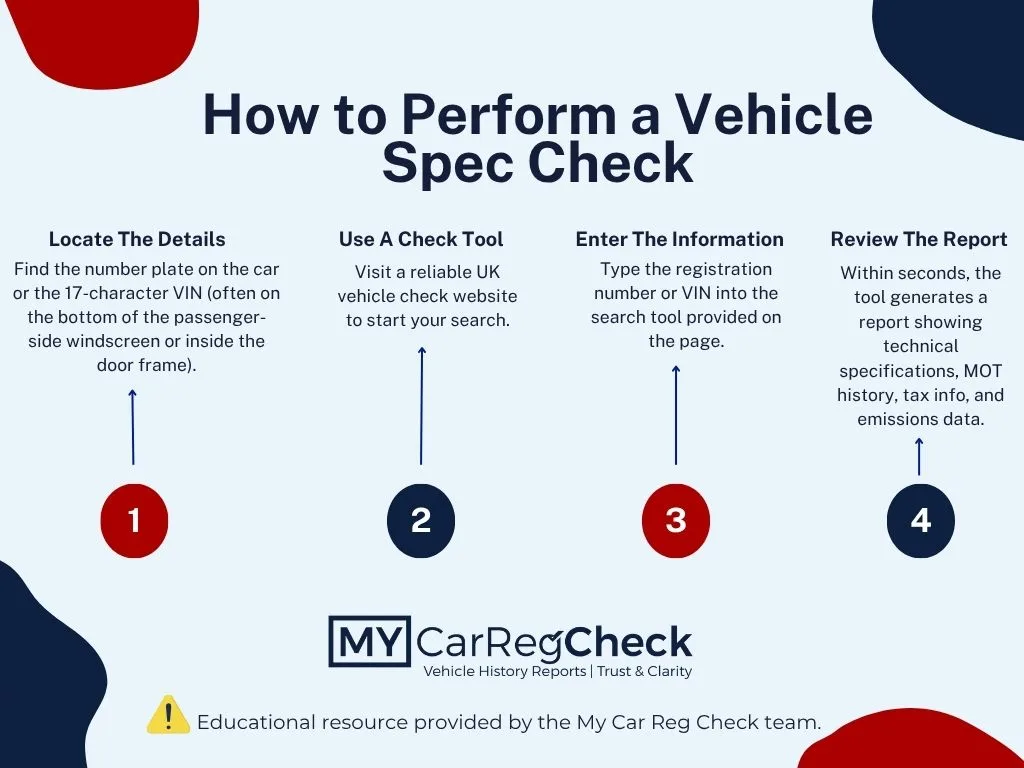
You only need one detail to get started: the vehicle’s car registration or, if you have it, the 17-character VIN. A car number plate check is usually enough for UK vehicles, which makes the process quick when you are comparing adverts or checking a car before viewing it.
Simply enter the registration number or VIN.
Type the registration number into the input box. If you are using a VIN lookup, enter all 17 characters so we can match the vehicle correctly.
Run the spec check.
Once you submit the search, we pull the linked specification data for that vehicle. There is no need to guess the model variant or search through brochures manually.
Review the result.
Your report can help you confirm the key details at a glance, including engine size, fuel type, transmission, trim, and other factory data. You can also check the vehicle's BHP and power output, see the fuel economy and emissions performance, and find the car's age and original registration date in one place.
Why Use a Vehicle Spec Check Before Buying?
A vehicle spec check helps you make sure the car you are paying for is the car being advertised. Two cars can look almost identical in photos, but one may be a lower trim, have a smaller engine, or sit in a different insurance group.
A quick spec check can help you:
- Avoid paying higher-spec money for a lower-spec car
- Spot differences in engine, gearbox, trim, and emissions before viewing
- Compare likely running costs more accurately
- Decide whether you should go further and run a full history check for issues such as outstanding finance
For example, two hatchbacks from the same year can look the same online, but one may be the entry-level model while the other has a more powerful engine and better trim. Checking the specs first helps you judge whether the asking price matches the actual vehicle.
Can a car spec check reveal a misdescribed vehicle?
Yes. One of the most practical uses of a spec check is spotting a misdescribed vehicle before you agree on a price or leave a deposit.
Misdescriptions are not always deliberate, but they still matter because they can affect insurance, running costs, and a realistic car valuation. A seller may list the wrong engine, gearbox, fuel type, or trim level, and that can affect value, running costs, and what you think you are buying.
What if the Engine Size Doesn't Match the Listing?
If the engine size or BHP in the listing does not match the spec report, do not brush it off as a small admin error. It can mean the advert is wrong, the car has been modified, or there has been an undeclared engine swap.
That matters because engine changes affect more than performance. They can affect insurance risk, emissions, road tax, and resale value. If the modification was not properly declared, it could also cause problems with insurance.
- Your next step is simple: stop and ask the seller to explain the mismatch. Ask for paperwork that supports it, such as invoices for the work, proof that the change was declared properly, and documents showing the V5C has been updated where needed.
A sensible check is to compare:
- The advert
- The spec report
- The V5C logbook
- Any service or modification paperwork
If the seller cannot clearly explain why the engine details are different, treat that as a warning sign. The same goes for power output that is higher or lower than expected, as that can suggest tuning, replacement parts, or an engine that is not original to the car.
Even when the car runs well, undocumented changes can make it harder to insure and harder to sell later. If the answers are vague, inconsistent, or unsupported by paperwork, the safest move is usually to walk away.
Does the car spec check show ULEZ compliance?
Yes. The spec check shows the vehicle’s Euro emissions standard and whether it meets current ULEZ rules. That gives you a clear answer before you buy, especially if you drive in London or other areas with Clean Air Zone charges.
This matters because two similar cars from the same model range can fall on different sides of the rules. One may meet Euro 6 and be compliant, while another, older or different-engine version may not. That difference can lead to regular daily charges if you drive into restricted zones.
The emissions data also helps you estimate likely tax and running costs. That means you are not just checking whether the car can enter a zone without a charge, but also getting a better idea of what it may cost to tax and run.
It is worth checking this before you agree on a price. A car that seems cheap at first can become much more expensive to own if it is non-compliant for the routes you use most often.
If you are comparing petrol, diesel, hybrid, or EV models, it also helps to check electric vehicle specifications alongside the emissions data for combustion vehicles. That way, you are comparing the real-world ownership picture, not just the sticker price.
- Important Safety Note: While our data is sourced from official Euro emissions records, local charging zones like London’s ULEZ are managed by specific local authorities. Databases can occasionally have sync delays. We strongly recommend verifying your registration on the official TfL portal or the government’s Clean Air Zone checker before making a final purchase.
Spec Check vs. Full Car History Check: What's the Difference?
A spec check and a full car history check answer two different questions.
A spec check tells you what the vehicle was built as. It helps you confirm the original make, model, trim, engine, transmission, emissions class, and other technical details linked to that registration.
A full history check looks at what has happened to the car since it left the factory. That is where you look for issues that can affect ownership, legality, and resale, such as:
- Outstanding finance
- Stolen markers
- Insurance write-off records
- Mileage concerns
- Previous keeper history
- Plate changes or other risk flags
- The easiest way to think about it is this: a spec check helps you confirm the car is the right version, while a history check helps you decide whether it is the right car to buy.
For example, a vehicle might have the exact trim and engine you wanted, but still carry a finance agreement or past write-off record. On the other hand, a car can have a clean history but still be misdescribed in the advert if the spec does not match the registration data. That is why many buyers do both checks before committing.
If you only want to verify the technical details, the free spec check is a good place to start. If you are close to buying and want a fuller picture of the risks, it makes sense to upgrade to a premium history check before any money changes hands.
FAQs
Car Specification Basics
What Are My Car’s Specifications?
Your car’s specifications are the main details that tell you exactly what vehicle it is. That usually includes the engine, fuel type, gearbox, trim, size, emissions, and sometimes performance figures such as top speed.
Can I Find My Car’s Specifications From Its Number Plate?
Yes, in most cases you can. Enter the UK registration number, and you can view the registered vehicle details linked to that car, which is much more reliable than guessing from the badge or relying only on the advert.
Using the Spec Checker
Is A Car Spec Check Free To Use?
Yes, the car spec check is free to use. You can enter a UK registration number and view the key vehicle details without paying.
Can I Use A Car Spec Check Before Buying A Used Vehicle?
Yes, and it is a sensible step to take before you view a car or leave a deposit. It helps you check that the vehicle matches the advert and gives you a clearer picture of what you are actually considering buying.
Can I Download a Report on My Car Details?
Yes. Once your free spec check report is generated, you can save the page as a PDF or print it. We recommend keeping a copy to compare against the physical V5C logbook when you view the vehicle.
Technical Vehicle Data
What Is My Car's Fuel Economy?
Your car’s fuel economy is the official MPG figure linked to that vehicle. Your car’s fuel economy is the official MPG figure linked to that vehicle. It gives you a useful baseline for estimating fuel costs, but your actual MPG may be lower or higher depending on how the car is used.
How Can I Check The Dimensions Of My Car?
You can check the vehicle’s dimensions by entering the registration number and viewing the spec details for that car. This usually helps you confirm the length, width, height, and other size information before you buy or park it somewhere tight.
Where Can I Find A Vehicle Weight Checker?
A vehicle spec check is one of the easiest ways to find the registered weight details for a car. Depending on the vehicle, the report includes kerb weight and other useful figures that help with towing, payload, or comparing similar models.
Data Accuracy & Coverage
How Accurate Is The Data Provided For My Vehicle?
The data is usually very reliable for checking the registered details of a vehicle. It is pulled from official and trusted specification sources, but it should still be treated as a strong starting point rather than a substitute for seeing the car itself.
If something looks off, compare:
- The spec check result
- The seller’s advert
- The V5C logbook
- The vehicle in front of you
That is especially important if the car has been modified or rebuilt.
Which Types Of Vehicles Are Covered By The Car Spec Check?
The check works for most UK-registered vehicles.
In most cases, that includes:
- Cars
- Vans
- Many light commercial vehicles
- Some motorcycles and other vehicle types
Coverage depends on the registration being valid and the underlying data being available for that vehicle.
Where Is The Car Spec Data Sourced From?
The data comes from official and trusted vehicle data sources.
That typically includes:
- DVLA registration records
- DVSA MOT data
- Manufacturer and industry specification databases
This helps you get a more dependable view of the vehicle than relying on an advert or seller description alone.
Feature-Specific Questions
Does A Car Spec Check Show MOT History And Mileage?
Yes, it can show MOT history with the mileage recorded for each MOT. That is useful for spotting things like gaps between tests, repeated advisories, or mileage that does not look consistent.
It is still worth knowing that MOT mileage is only part of the picture. It shows what was recorded at test dates, but if you want a deeper view of the car’s past, a full history check is the better next step.