A Cat N car label means the vehicle is an insurance company's write-off with cosmetic damage or other non-structural damage, where the cost of repair was higher than the car’s market value. In simple terms, it is a written-off car that has not lost its structural integrity.
This is the core category N meaning: the car may have damage to panels, lights, wiring, brakes, steering, or infotainment, but not to the chassis, frame, or crumple zones. That is why Cat N is different from Cat S, which involves structural damage.
The system changed in October 2017, when Category D was replaced by Category N under the ABI salvage framework.
A Cat N marker does not always mean the car is unsafe or cannot be repaired. It means the insurer decided it was uneconomical to repair at the time. Before buying, a vehicle history check can help confirm the car’s Cat N status and wider write-off status.
What is "Non-Structural" Damage?
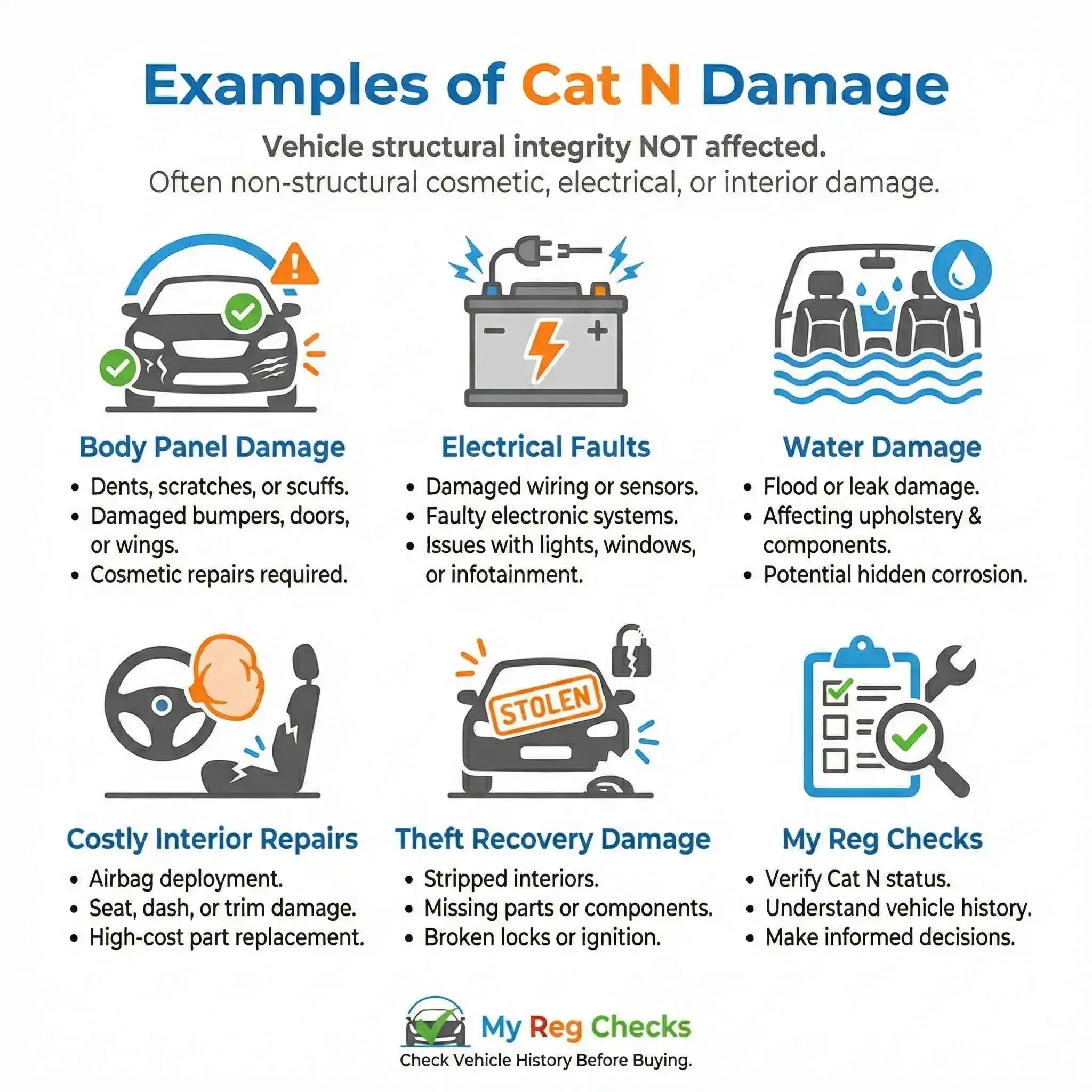
“Non-structural” damage means the car’s main shell has not been harmed. In other words, the chassis, frame, and crumple zones are not the reason it was written off.
That can include obvious items such as:
- Bumpers
- Wing mirrors
- Lights
- Body panels
- Upholstery and interior trim
But this is where many buyers get caught out: non-structural does not always mean minor. A Cat N car can still have faults in the steering, suspension, brakes, sensors, wiring, or infotainment system. None of those parts is classed as structural, but they can still be expensive to fix and important for safety.
That is why repair quality matters more than the label alone. If a Cat N car has been repaired to a high standard, it may be fine to be put back on the road. If the work was rushed, the problems may only show up later, even if the car passes a basic MOT check.
Cat N vs. Cat S: Understanding the Difference
Both Cat N and Cat S mean the car is a total loss in the eyes of the insurer. The difference is not whether the car was written off, but what kind of damage caused that decision.
| Category | What it means | Type of damage | Can it be repaired? | Key point for buyers |
| Cat N | Non-structural write-off | Damage does not affect the chassis, frame, or crumple zones | Usually yes | Problems may still involve costly electrics, steering, brakes, or suspension |
| Cat S | Structural write-off | Damage does affect the chassis, frame, or another structural part of the car | Usually yes | Repairs are more serious because the car’s structure has been damaged |
People often assume Cat N is always light damage. It is not. A Cat N car may still need expensive work before returning to the road, especially if the issue involves wiring, steering components, or suspension.
If you are comparing two used cars and want to check car category before buying, a car write off check is a sensible first step. It helps confirm whether you are looking at a Cat N or Cat S vehicle and gives you a clearer view of the risk.
Why a Car History Check is Critical for Cat N Vehicles
A vehicle history check is one of the quickest ways to cut through guesswork with a Cat N car. Many sellers are honest, but some “forget” to mention a past write-off, especially in a private sale where the buyer has less protection than they would with a dealership.
That is why a good idea before buying a second-hand car is to run a proper check first.
A proper check can help you answer practical questions such as:
- Whether the damage history lines up with the asking price
- Whether you may face issues with cat n insurance later on
- Whether the seller has been fully transparent
At My Car Reg Check, our vehicle history checks use data from sources that include the Motor Insurance Anti-Fraud and Theft Register (MIAFTR). MIAFTR is a central database used by UK insurers. Instead of relying on a description like “light damage, repaired and back on the road”, you can look for the write-off category, the recorded date of damage, and, in some cases, clues about the nature of the claim. That gives you a stronger starting point before you inspect the car in person or speak to an insurer.
Can You Insure a Category N Car?
Yes, you can insure a Category N car. But it is often a bit more hassle, and sometimes more expensive, than insuring a similar car with no write-off history.
The issue is not that Cat N cars are illegal or automatically unsafe. It is that insurers know the vehicle has already been written off once, so they tend to look more closely at the repair history, current condition, and likely resale value.
That can mean:
- Fewer insurers are willing to quote
- Higher premiums
- Lower claim payouts if the car is written off again
- Extra paperwork before the cover starts
Some mainstream providers will insure a Cat N car, while others may ask for more evidence first. For example, they may want clear repair invoices, recent MOT details, photos of the work, or even an engineer’s report to show the car is safe to drive.
This is where buyers sometimes get caught out. The purchase price may seem attractive, but the real cost can become much clearer once the insurance quotes come in. That is why it is worth checking insurance options before you buy, not after.
One more point matters: you should always declare the car’s Cat N history when applying for cover. If you do not, the insurer could reduce a future payout or refuse a claim altogether.
Should You Buy a Cat N Car? Pros and Cons
A Cat N car can be a smart buy, but only in the right circumstances. The label on its own does not make it a bad car. What matters is what was damaged, how well it was repaired, and whether the price truly reflects the risk.
Pros
- Usually cheaper to buy, often around 10–25% below market value
- No recorded structural damage to the chassis or frame
- Can offer strong value if repairs were done properly and fully documented
Cons
- Often harder to insure and more expensive to cover
- Lower resale value when you come to sell
- Hidden faults can still exist, especially with electrics, steering, suspension, sensors, or airbags
A Cat N car is often a better fit for a confident buyer than for someone who wants a simple, low-risk purchase. If the seller can provide clear evidence of proper repairs, such as invoices, photos, and an independent inspection, the car may be worth considering. If there is little paperwork and the seller is vague about what was damaged or repaired, the risk is much higher.
If you are buying from a private seller, be extra careful. Ask what happened, who repaired it, and what parts were replaced. If the answers are unclear or the paperwork is missing, walk away. A lower price means very little if the car turns into an expensive problem a few months later.
How to Check if a Cat N Car is Safe to Drive
The safest way to look at a Cat N car is to treat it as a repaired accident vehicle, not simply a cheaper used car. The Cat N label only tells you the damage was non-structural. It does not tell you whether the repair was done properly, cheaply, or only made to look good on the surface.
The best first step is a professional pre-purchase inspection. A qualified mechanic can check the areas most buyers will miss, including the steering, suspension, brakes, wiring, sensors, and any signs of water or electrical damage. That gives you a far more reliable view of the car’s condition than a short test drive or a clean-looking interior ever could.
When you inspect the car yourself, focus on a few practical checks.
1. Check the warning lights properly
Turn the ignition on before starting the engine. The airbag, ABS, and engine management lights should all come on briefly. Once the engine starts, they should go out within a few seconds. If a light never appears at all, that can be a warning sign in itself.
2. Be cautious with airbag systems
A missing airbag warning light does not always mean everything is fine. In some cases, poor repair work is used to hide faults rather than fix them. If there is any doubt, ask for an independent diagnostic scan.
3. Look closely at panel gaps
Check the spacing around the bonnet, doors, and boot. Uneven gaps from one side to the other can suggest poor-quality repair work or damage that was not corrected properly.
4. Watch for signs of repainting
Look around door shuts, rubber seals, wheel arches, and the fuel flap for overspray, rough paint edges, or slight colour differences. That does not always mean the car is unsafe, but it does tell you where repairs were carried out.
5. Test the electrics under load
With the engine running, switch on the lights, air conditioning, heated windows, and infotainment system. Watch for flickering screens, warning messages, faulty parking sensors, or locking issues. These can point to wiring faults or hidden electrical problems.
Finally, ask for repair invoices, photos, and parts receipts. If the seller cannot explain clearly what was damaged and how it was repaired, take that seriously. A Cat N car can be safe to drive, but only when the quality of the repair matches the story being told.
Selling a Cat N Car: Your Legal Obligations
If you sell a Cat N car, be upfront about it from the start. That means telling any buyer, dealer, or part-exchange business that the vehicle is a previous insurance write-off and making sure the advert, messages, and paperwork do not give a misleading impression.
For commercial dealerships and motor traders, failing to disclose a vehicle’s Category N history may be treated as a misleading omission because it withholds important information from the buyer. That creates regulatory risk for the seller and may also give the buyer legal grounds to challenge the sale and seek an appropriate remedy.
Even in a private sale, honesty matters. If you hide a Cat N history and the buyer later finds it through a vehicle check, they may use Citizens Advice’s used-car guidance or its misdescribed private-sale complaint template to challenge the sale. You could end up facing a refund demand, a dispute, or legal action for misrepresentation.
The sensible approach is simple:
- State clearly that the car is Cat N
- Keep repair invoices, photos, and MOT records ready
- Describe the damage and repairs as accurately as you can
- Never assume the buyer “doesn’t need to know”
- That protects the buyer, and it protects you, too. A transparent sale is far less likely to unravel later.
FAQs
Does Cat N show on the V5C logbook?
Unlike Category S, the DVLA does not issue a new V5C logbook stamped with a structural marker for Category N vehicles. However, you are legally mandated to notify the DVLA immediately if your insurance company writes off your car and you choose to keep it. Failing to report an insurance total loss to the DVLA is an offense that carries a statutory £1,000 fine.
Does a Cat N car need a new MOT?
Not automatically. A Cat N marker does not automatically mean the car needs a new MOT, because the usual MOT timetable still applies. That said, if the car has been repaired after a write-off, getting a fresh MOT is still a sensible extra check on roadworthiness.
How much does Cat N devalue a car?
There is no fixed percentage, but Cat N cars usually sell for less than equivalent cars with a clean history. A practical rule of thumb is that the discount often sits around 10% to 25%, and can be more if the repairs are poorly documented, the damage involves electrics, or buyers see the car as harder to insure or resell.
Is it worth buying a car with Cat N?
It can be, but only when the discount is large enough to justify the extra checks. A Cat N car has not been written off for structural damage, which is a positive, but buyers still need to look closely at repair quality. That is why paperwork matters: repair invoices, photos, service history, and a proper inspection reveal far more about the car’s condition than the Cat N label ever will.
Which is better, Cat N or Cat S?
Cat N is usually the easier one to live with because the damage was non-structural. Cat S means the car has had structural damage to areas such as the chassis or frame, so the stakes are higher if the repair work was poor. That said, the label is only the starting point. A badly repaired Cat N can be a worse buy than a carefully repaired Cat S, which is why history, evidence, and inspection matter more than assumptions.
Does Cat N affect insurance?
Usually, yes. Some insurers will cover a Cat N car without much fuss, while others may charge more, offer fewer policy choices, or reduce the payout if the car is written off again. That is why insurance should be part of the buying decision, not an afterthought.
Is Cat D better than Cat N?
Not really. Cat D is the older label, and Cat N is the category that replaced it in 2017.
So the better question is not “Cat D or Cat N?” but “What was actually damaged, and how well was it repaired?” An older Cat D car with clear paperwork and careful repairs may be a better buy than a newer Cat N car with missing history and poor-quality work.
How to remove Cat N from a car?
You cannot remove a Cat N marker from a car’s history. Once the vehicle has been recorded as Category N, that status stays with it for life, even if the repairs were carried out perfectly and the car has been trouble-free ever since.
What you can do is reduce the concern around it. Keep repair invoices, before-and-after photos, MOT records, and inspection reports. That will not erase the Cat N history, but it can make the car easier to insure, easier to explain, and easier to sell.
Final Verdict: Is Cat N a Deal Breaker?
Not necessarily. A Cat N car is not an automatic no; it is a car that needs better evidence before you commit. The real question is not whether the Cat N label exists, but why it was applied and how the car was put right.
If you are seriously considering one, take a simple two-step approach:
- Run a full vehicle history check first
- Have the car looked at by an independent professional before buying
That combination tells you far more than the advert ever will. The history check helps confirm the write-off record and timeline. A professional inspection helps you judge the repair quality, spot warning signs, and decide whether the discount is worth the risk.
So, is Cat N a deal breaker? No. But it should never be a blind bargain either.