Bikes
Bikes Vans
Vans Motorhomes
How Much Is the ULEZ Charge and When Must I Pay?
The ULEZ charge is £12.50 per day for cars, vans, minibuses, motorcycles and other eligible light vehicles that do not meet the required emissions standard. You can pay it by midnight on the third day after the journey, or up to 90 days in advance.
You can think of it like this: if you drove into the zone on Monday, you have until 11:59 pm on Thursday to pay. If you already know you will be travelling, paying ahead removes the risk of forgetting.
If you are not sure whether you need to pay, run a ULEZ compliant checker before you travel. This is especially useful if you drive different vehicles, use a work van, or have recently bought a car and have not yet confirmed whether it meets the standard.
For regular trips, TFL Auto Pay is usually the safest option because it records chargeable journeys and bills them automatically each month, with no registration or renewal fee. It is a sensible backup if you drive in and out of London often and want to reduce the chance of an avoidable fine.
If your journey also takes you into central London, remember that ULEZ and the congestion charge are separate schemes, so some drivers may need to pay both depending on where and when they travel.
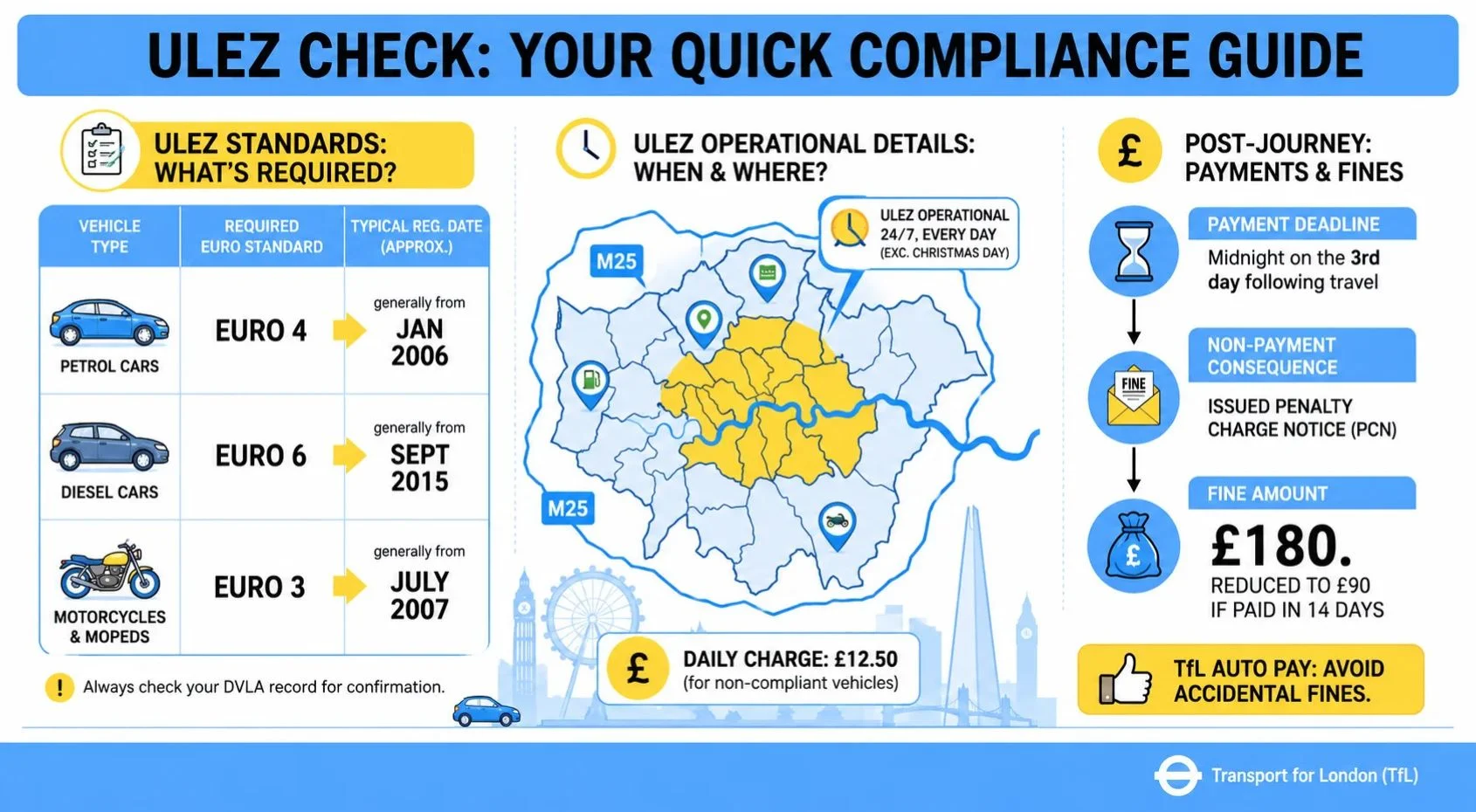
ULEZ Compliance Rules by Vehicle Type
The easiest way to answer which cars are ULEZ compliant is to match the vehicle type and fuel type to the right Euro standard. TfL does not judge compliance by registration year alone. It uses the vehicle’s officially recorded emissions data, and for diesel vehicles the key factors are harmful pollutants such as Nitrogen Oxides (NOx) and Particulate Matter (PM), rather than CO2 by itself.
These guide dates are a useful starting point, but they are still only a guide. A vehicle can be older than the usual cutoff and still be compliant, which is why it is better to check the registration rather than rely on age, road tax, or how the vehicle is described in a listing.
Petrol Cars (Euro 4)
Petrol cars must meet Euro 4 emissions standards to avoid the daily charge. Some older petrol models may still be compliant if their recorded emissions meet the required NOx limit.
Diesel Cars (Euro 6)
Diesel cars are judged more strictly and must meet Euro 6 standards. This is where many drivers get misled by low road tax, because tax bands are based on CO2, while ULEZ compliance is based on harmful exhaust pollutants such as NOx.
Vans and Light Commercial Vehicles
For petrol vans, the ULEZ threshold is Euro 4, while diesel vans and other light commercial vehicles need Euro 6. If you use a van for work and drive into London often, a non-compliant vehicle can become a constant business cost rather than a one-off charge, which is why a reg check before purchase matters.
Motorcycles and Mopeds
Motorcycles, mopeds, motorised tricycles, and quadricycles must meet Euro 3. Even though they are smaller vehicles, the daily ULEZ charge is still £12.50 if they are non-compliant, which often surprises riders who assume the charge only applies to cars and vans.
How to Check Your Vehicle's Euro Emission Standard Manually
If you want to check it yourself, start with the V5C logbook rather than the badge on the boot or the age someone claims the car is. A proper official DVLA data check is still the safer option, but the logbook can help you confirm whether the vehicle details line up with what you expect.
First, look at section D.2 on the V5C. This shows the vehicle’s model and variant details, which helps you confirm you are checking the correct version of the car. That matters because the same model name may have been sold with different engine options, and those versions can have different emissions ratings.
Then move to the emissions part of the V5C and check whether the Euro standard is shown there. On newer vehicles, the Euro emissions standard may be listed on the V5C, but it is not always present in a way that gives you a clear ULEZ answer, which is why the registration check remains the more reliable next step.
A simple manual check looks like this:
- Confirm the make, model, engine and variant in D.2.
- Check the fuel type shown on the V5C.
- Look through the emissions section for the Euro standard and related emissions data.
- Compare that with the ULEZ rule for that vehicle type.
If anything does not match cleanly, use the registration for a follow-up check and check MOT and tax status before you rely on the vehicle for London travel.
Do not judge compliance by the way the car looks. A restyled model, aftermarket trim, or a newer-looking interior can make an older vehicle seem newer than it really is, even when its recorded emissions standard says otherwise.
Private number plates can be misleading for the same reason. They can make it harder to tell how old a vehicle is at a glance, so relying on the plate alone is risky. If you need to check your car's age, use a DVLA-backed record rather than the registration style on display.
It is also worth taking a moment to check your V5C logbook issue date and make sure the document is up to date. If the car has been modified, imported, re-registered, or has a private plate, an outdated logbook or an incomplete advert can give the wrong impression, so the recorded vehicle details should always be checked against the registration.
Exemptions: Who Doesn't Have to Pay ULEZ?
TFL does not treat every non-compliant vehicle the same. Some vehicles are fully exempt, while others can qualify for a temporary grace period, so it is worth checking the exact category before assuming the charge applies.
The main fully exempt categories include:
- Vehicles built before 1 January 1973
- Vehicles over 40 years old that are registered with the DVLA in the historic tax class
- Specialist agricultural vehicles
- Military vehicles
- Certain non-road-going vehicles allowed on the highway, such as excavators, and some mobile cranes
Disabled drivers are handled through grace periods rather than a blanket exemption. Vehicles in the DVLA’s “disabled” or “disabled passenger vehicle” tax class can qualify for a grace period until 24 October 2027, and wheelchair-accessible cars and vans that have been properly converted can qualify until 25 October 2027.
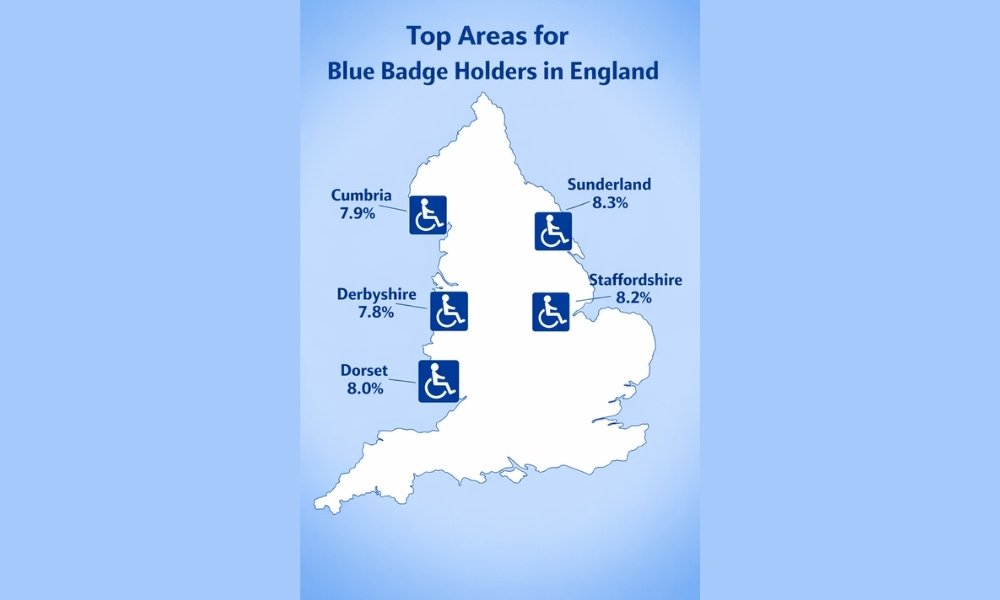
There is also a disabled benefits grace period for some people who receive qualifying mobility benefits or meet specific medical criteria. In some cases, it can also apply to a nominated driver’s vehicle if it is used only for the disabled person’s personal needs. However, Blue Badge holders are not automatically exempt, so this is one area where checking the exact TFL rules matters.
What Happens if You Don't Pay the ULEZ Charge?
If you drive a non-compliant car, van, motorcycle, moped, or similar light vehicle in the ULEZ and do not pay the daily charge, TFL can issue a Penalty Charge Notice for £180. If you pay within 14 days of service, that drops by 50% to £90.
These notices are enforced through Automatic Number Plate Recognition cameras, which capture a number plate read and a still image of the vehicle as it travels within the charging zone. TFL uses that camera evidence to enforce the charge, so most unpaid journeys are unlikely to escape notice.
If you ignore the Penalty Charge Notice, it can rise further. According to TFL, if you do not pay or challenge it within 28 days, the amount increases to £270, so the cheapest outcome is still to deal with it quickly.
TFL ULEZ Scrappage Scheme Explained
The August 2023 expansion of the scrappage scheme opened support to all London residents with an eligible non-compliant car or motorcycle. At that stage, the headline payments were up to £2,000 for scrapping a car and up to £1,000 for scrapping a motorcycle, with higher support available in some cases for wheelchair-accessible vehicles, vans, minibuses, small businesses, and charities.
The scheme was designed to improve air quality by helping people move away from older non-compliant vehicles before the London-wide ULEZ expansion. It ran from 30 January 2023 until 8 September 2024, and it is now closed to new applicants.
If your vehicle has just failed the check, the next step is to compare the ongoing ULEZ cost against the cost of replacing it, and if you are considering a switch, an electric vehicle data check can help you review the alternative properly. A registration check gives you a clearer starting point, and a fuel economy and MPG checker can help you compare day-to-day running costs before you decide whether to keep, sell, or replace the vehicle.
Does ULEZ cover the M25?
No. The London ULEZ covers all London boroughs, but the M25 itself is not inside the zone. Outside London, some cities use different emission zones or Clean Air Zones (CAZ), so it is worth checking those separately.
Frequently Asked Questions
How much is the daily ULEZ charge and what is the payment deadline?
The daily ULEZ charge is £12.50 for most cars, motorcycles, vans, minibuses and other light vehicles that do not meet the standard. You must pay by midnight on the third day after the journey, although TfL also allows payment up to 90 days in advance.
Which petrol and diesel cars are exempt from ULEZ compliance fees?
Petrol cars that meet Euro 4 and diesel cars that meet Euro 6 do not pay the ULEZ charge. As a rough guide, that usually means petrol cars first registered after 2005, and diesel cars first registered after September 2015.
What happens if you fail to pay the ULEZ charge on time?
If your vehicle is not compliant and you do not pay by midnight on the third day after travel, TfL can issue a £180 Penalty Charge Notice. That is reduced to £90 if you pay within 14 days.
Who is fully exempt from paying the daily London ULEZ charge?
Full exemptions include historic vehicles in the historic tax class, vehicles built before 1 January 1973, specialist agricultural vehicles, military vehicles, and certain non-road-going machines that are allowed on the road for limited purposes.
By contrast, vehicles in the disabled tax class and wheelchair-accessible vehicles are usually covered by grace periods rather than a permanent exemption.
Are hybrid cars exempt from ULEZ?
Not automatically. A hybrid still has to meet the same petrol or diesel emissions standard as any other vehicle, so some hybrids are compliant, and some are not.
Where can I find my car's Euro emission standard manually?
Start with your V5C logbook: check section D.2 for the exact model and variant, then look in the emissions section to see whether the Euro standard is listed. If the logbook does not give a clear answer, a registration-based ULEZ check is the safer option.
Does the ULEZ charge apply on weekends or bank holidays?
Yes. ULEZ runs 24 hours a day, every day of the year, including weekends and bank holidays, with Christmas Day as the main exception.
Is 2015 diesel ULEZ compliant?
Sometimes, but not always. A 2015 diesel will usually only be ULEZ compliant if it meets Euro 6 standards. Because the main guide date begins around September 2015, it is important to check the exact registration and emissions record rather than assume that every diesel registered in 2015 qualifies.